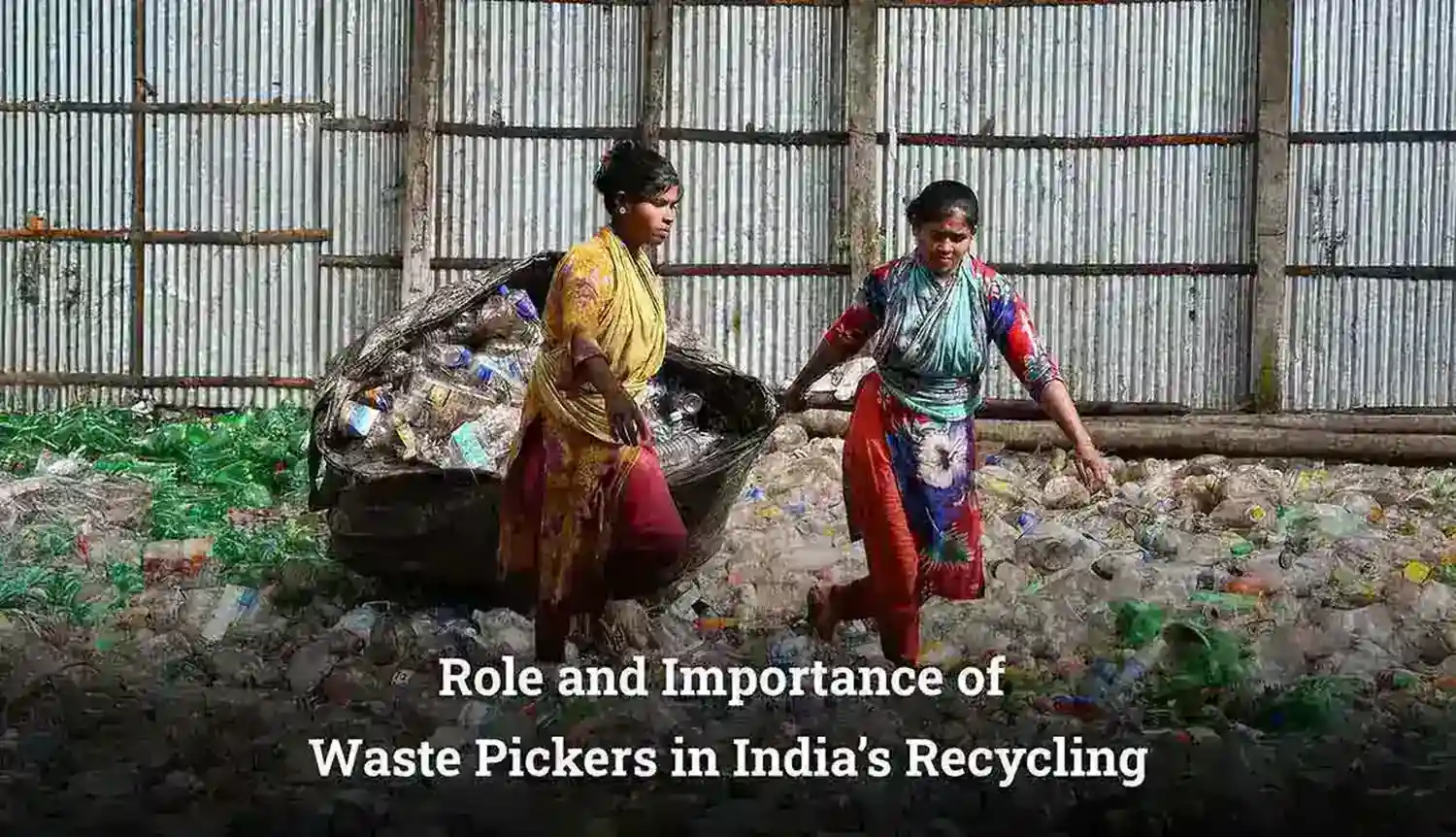
A large population that tends to work in the periphery of the formal economy has contributed to the survival and efficiency of the global recycling industry especially in the emerging economies. These people are called waste pickers and they are the main actors in the material recovery business in that there is such a big gap between discarded wastes and the high-technological processing units which convert waste into wealth. The manual labor of waste pickers is in a world that is becoming more and more overwhelmed by plastic pollution, where millions of tons of recyclables are being removed out of landfills and oceans annually. They do not serve the purpose of manual laborers; they serve the purpose of expert segregation. They also have intuitive knowledge of the types of polymers, grades of paper, and values of metals that are yet to be duplicated by many automated systems. Through urban environments, community bins, and landfills, waste pickers harvest value when no one can perceive more than filth, which is the necessary feedstock needed to have a circular economy. Their hard work would break down the recycled plastic, glass, and metal supply chains and cause the virgin material manufacturing to become more active, and a resultant rise in carbon emissions. Although they play a vital role in the environment, these employees usually have to overcome a lot of social and financial challenges. Appreciating the role of the waste picker is the initial step towards having an inclusive and sustainable waste management system, which appreciates the planet and the people who safeguard it.
Introduction
The waste management landscape is evolving at a high pace yet the most crucial aspect of it is the human factor. In a nation that has more than 62 million tons of waste generated in a year, waste pickers in India are the pillars of the recovery process where they manage close to 15-20 percent of the total waste produced.
The availability of waste pickers in India is what makes sure that valuable materials are retrieved before they can cause harm to the environment. In order to know the future of sustainability, we need to consider:
- Socio-economic background of these employees.
- The amount of plastic they redirect out of delicate environments.
- There is a possibility of the inclusion of the waste pickers in the formal economy in India.
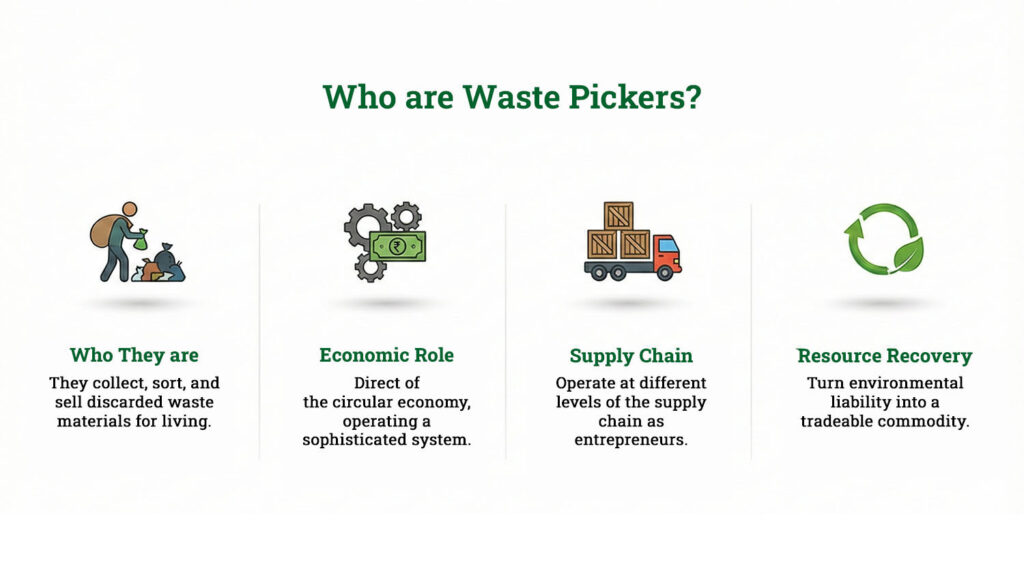
Who are Waste Pickers?
Waste pickers in India refer to those people who make a living by collecting, sorting and selling waste materials that have been discarded. They are the direct employees of the circular economy.
These people are at the different levels of the supply chain. To know the waste pickers, it is essential to note that they are entrepreneurs who operate a sophisticated system of kabadiwalas (scrap dealers) and processors. Theirs is the definition of resource recovery because they turn an environmental liability into a tradeable commodity.
Types of Waste Pickers
The profile of these workers does not exist, but there are some types of waste pickers distinguished by the places of work and their integration into the formal order.
These types of waste pickers are vital to an organization that wants to adopt an inclusive Extended Producer Responsibility (EPR) program. Such kinds of waste pickers consist of:
Informal Waste Pickers
The informal waste pickers are those types of waste pickers who collect waste not in an official government or city contract. They go around picking trash in street bins, dumping places or homes on their own. Since informal waste pickers are not acknowledged, they do not get access to medical care, just prices, and protective clothing and yet they are the ones who collect most of the plastic in urban areas.
Formal Waste Pickers
Formal waste pickers are the ones incorporated into the municipality waste collection system or those hired by the private waste collection firms. Formal waste pickers unlike their informal counterparts normally have access to ID cards, uniforms, and sorting facilities (Material Recovery Facilities). Such a shift of informal to formal is one of the main objectives of the sustainable recycling industry.
What are the Problems Faced by Waste Pickers in India
The existence of an employee in this industry is a life full of struggle. The issues of waste pickers are complex as they can be connected not only with health risks but also with social exclusion. Waste pickers in India despite being environmental heroes often are faced with:
- Health Hazards: Continuous contact with toxins, stabbing materials, and pathogens without the use of PPE.
- Economic Instability: The scrap materials have variable prices in the market which implies that they are usually living on their fingertips.
- Harassment: This is usually a result of a lack of legal status, which can cause harassment by the government or individuals.
- Child Labor: In the lowest stratified areas, the issues of waste pickers continue to the subsequent generation where children are forced into the business to provide family wages.
Importance of Waste Pickers
The role of waste pickers in the contemporary industrial setup is unimaginable to a fault. They offer a service which the municipal corporations can usually not afford to scale.
Waste pickers are a significant phenomenon, whose impact is experienced in some important fields:
- Landfill Diversion: The latter prolong the landfill life considerably by eliminating recyclables.
- City Savings: They save millions of dollars of collecting and transportation fees to city governments by diverting waste.
- Climate Mitigation: Recycle 1 ton of plastic = about 1.5 tons of 1 -Carbon Dioxide (CO 2 ) emission; this is enabled by sorting their efforts.
Role of Waste Pickers in Recycling
The waste pickers play the primary sort in the recycling value chain. Most of the plastic would not be able to be processed by machines without their intervention as they are too contaminated.
Waste pickers are engaged in the role of:
- Source Segregation: Recognizing the various polymers (PET, HDPE, PP) at the collection point.
- Contamination Control: Washing and preparing the scrap dealer materials.
- Market Intelligence: Diverting the materials to the individual recycling facilities that are capable of processing them, as a way of ensuring a continuous supply of feedstock to the industry.
How Organizations Can Support Waste Pickers
Banyan Nation feels that recycling needs to be universal in the future. Organizations have the role in supporting this community to avoid charity but structural change.
- Digital Integration: Tracking collections with the help of apps and data tools and providing fair and transparent payments.
- PPE Provision: Fitting high-quality gloves, masks, and boots to minimize health risks.
- Formalization: Assisting the informal waste pickers to become formal waste pickers through supplying them with identity cards and connecting them to municipal networks.
- Direct Sourcing: Brands may source their recycled material out of organizations in which they have ethical and traceable connections within the picker community.
Conclusion
The process of e-waste through the hands of waste pickers starts with the process of e-waste, which is turned into a high-quality resin pellet through recycling. These people are the heroes of our planet that have no names. This not only cleans up our cities, but also creates a more equal society, as we not only help to stop the issues of waste pickers, but also in India, we empower waste pickers to become part of a formalized, tech-enabled value chain. We are aware that at Banyan Nation, we cannot achieve the plastic crisis mission without the mission to empower people who can make recycling a reality.
FAQ's
What is the role of waste pickers in managing waste?
The role of waste pickers is to collect and sort recyclable materials from the waste stream. They act as the primary filters that ensure high-value materials are diverted from landfills and sent to recycling facilities.
How do waste pickers support a circular economy?
They support the circular economy by reclaiming resources that would otherwise be lost. By providing clean, sorted feedstock to recyclers, they reduce the need for virgin plastic production and help keep materials in use for longer.
Where do waste pickers usually collect waste from?
Depending on the types of waste pickers, they collect waste from residential doorsteps, community dustbins, commercial areas, and large-scale municipal dump sites or landfills.
Making recycled packaging the norm.
CITATIONS:
- Chintan Environmental Research and Action Group. (2023).
Giving Waste Pickers a Voice.
Retrieved from:
https://www.chintan-india.org/ - WIEGO (Women in Informal Employment: Globalizing and Organizing). (2024).
Waste Pickers: Statistics and Contribution.
Retrieved from:
https://www.wiego.org/informal-economy/occupational-groups/waste-pickers - The World Bank. (2022).
What a Waste 2.0: A Global Snapshot of Solid Waste Management to 2050.
Retrieved from:
https://datatopics.worldbank.org/what-a-waste/ - Ministry of Housing and Urban Affairs, Government of India. (2024).
Swachh Bharat Mission (Urban) – Guidelines for Informal Sector Integration.
Retrieved from:
https://sbmurban.org/
 What Is the Waste Disposal Hierarchy? 5 Steps Explained
 What Is ABS Plastic? Properties, Uses & Recycling
 International E-Waste Day 2026: What It Means and How to Take Part
 What is Waste Disposal: Methods, Types, and Real-World Examples
 What Is Polyolefin? Types, Properties, Uses and Recyclability