Introduction
Our natural world is going through unprecedented threats from climate change, biodiversity loss, and uncontrolled plastic pollution day by day. As society consumes resources unsustainably, understanding environmental conservation is critical, the need of environmental conservation is an urgent call to action for individuals, organisations and governments. Millions globally unite on World Environment Conservation Day every year to raise awareness and promote sustainable practices. However, observing World Environment Conservation Day once a year is not enough, whereas we must integrate protective measures into our daily lives and value systems. For centuries, the environment has provided essential ecosystem services, including clean air, water purification, and raw materials. Unfortunately, our ‘buy-use-throw’ economic model has degraded these systems. Environmental conservation should be in a transition phase towards a circular economy that mitigates plastic pollution and protects our biodiversity.
What Is Environmental Conservation?
Environmental conservation in its original sense refers to the protection, responsible management, and restoration of the natural environment to ensure these resources remain available for future generations. Conservation differs from preservation which seeks to keep nature completely untouched, whereas conservation acknowledges humans need natural resources. The true environmental conservation revolves around utilization of resources sustainably without depletion while balancing human needs with the earth’s carrying capacity.
Core focus areas include:
- Sustainability: Meeting demands without depleting future resources.
- Biodiversity: Protecting the variety of life forms that keep ecosystems resilient.
- Resource Management: Monitoring the extraction and use of materials.
The Need for and Importance of Environmental Conservation
The immediate requirement for the conservation of the environment emerges because of the uncontrollable consumption of natural resources beyond its limit which leads to severe ecological collapse worldwide. Understanding the importance of environmental conservation is imminent because our economy, public health, and social wellbeing are deeply dependent on the natural world.
Understanding the importance of environmental conservation helps us address pressing ecological threats, especially plastic pollution. Creating proper awareness is highly important to convince people and make them understand the importance. Here is why the need of environmental conservation is required:
- Climate Regulation: Healthy forests and oceans control massive carbon emission, mitigating global warming.
- Food Security: Global food crops rely on natural growth process and without habitat protection, agriculture suffers.
Public Health: A balanced ecosystem limits infectious diseases and provides natural components for modern medicines and a dedicated health sector.
Benefits of Environmental Conservation
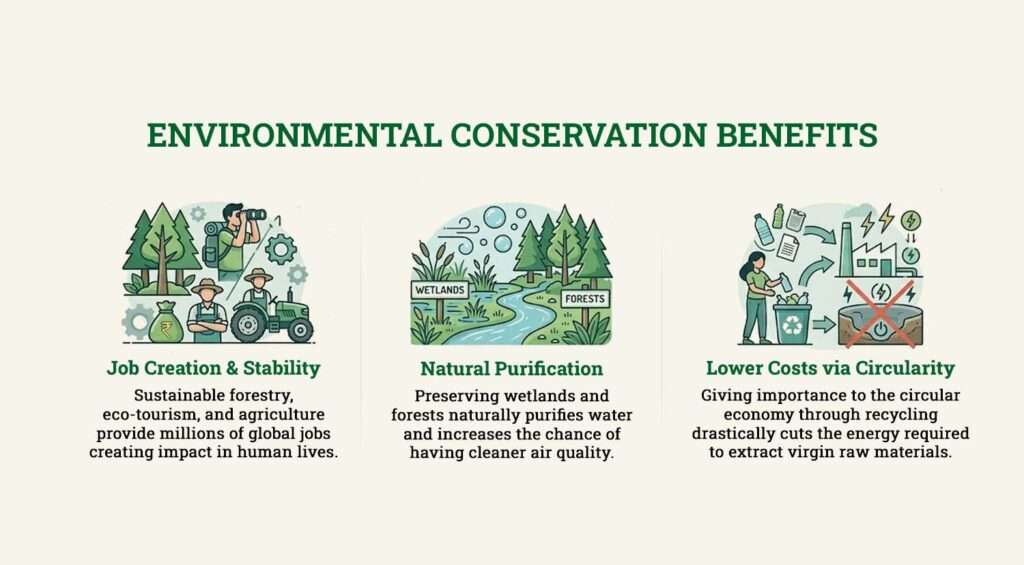
The incomparable benefits of environmental conservation extend to different sectors such as the global economy and human health. On days such as world environment conservation day, emphasizing the importance of environmental conservation reminds us of the value gained when we protect nature.
These benefits include:
- Economic Stability – Sustainable forestry, eco-tourism, and agriculture provide millions of global jobs creating impact in human lives.
- Clean air and water – Preserving wetlands, forests naturally purify water and increases the chance of having cleaner air quality.
- Lower Production Costs – Giving importance to the circular economy through recycling drastically cuts the energy required to extract virgin raw materials.
Types of Environmental Conservation
Experts from different sectors categorize protective efforts into various types of environment conservation to manage our planet’s resources. Understanding the different types of environment conservation helps tackle specific ecological challenges with designed strategies to build a strong environmental conservation framework.
Common examples of environmental conservation include:
- Forest Conservation – Protecting forests and historical woodlands while promoting sustainable alternatives and systematic logging
- Soil Conservation – Maintaining soil fertility for the survival of vegetation and food security.
- Marine and Water Conservation – Mitigation of plastic pollution and controlling overfishing leading to depletion of marine wealth
- Wildlife Conservation – Protecting endangered species and natural habitats.
- Air Quality Conservation – Choosing sustainable clean energy alternatives to reduce pollution.
Banyan Nation’s Recycling Helps Conserve the Environment
For addressing the plastic waste crisis, it requires innovative industrial planning and solutions. Environmental conservation is completely realized when companies take responsibility for their product lifecycles and adopt circular working options.
Advanced recycling processes at Banyan Nation’s directly support these conservation goals. Banyan Nation focuses on recovering discarded plastics by utilizing highly efficient cleaning technologies, where high-quality recycled granules are produced to replace virgin plastics. While comparing, recycled plastics reduce energy consumption by 70% – 88% to virgin plastic production where this system helps to reduce the usage of massive amounts of fossil fuels. This process assists in keeping plastics in the economy and out of the habitat destruction which protects our biodiversity.
Conclusion
Realising the importance of environmental conservation is the vital first step towards building a sustainable future. By committing to the circular economy and systematic plastic recycling, we ensure our planet remains clean, healthy, and capable of supporting all life for generations to come.
FAQ's
What are examples of environmental conservation?
Great examples of environmental conservation include protecting wildlife, replacing single-use plastics with reusable alternatives, utilizing renewable energy, and promoting scientific recycling programs.
How does the circular economy support environmental conservation?
The circular economy supports the benefits of environmental conservation by eliminating the linear buy-use-throw model. It emphasizes keeping materials in use for as long as possible through high-quality recycling, lowering the need for virgin raw material extraction.
What is the role of individuals in environmental conservation?
Individuals play a crucial role in environmental conservation by adopting sustainable habits. Small actions like sorting waste, conserving water, and choosing eco-friendly products collectively create a massive positive impact. Such small actions from masses eventually leads to bigger impact
 What Is the Waste Disposal Hierarchy? 5 Steps Explained
 What Is ABS Plastic? Properties, Uses & Recycling
 International E-Waste Day 2026: What It Means and How to Take Part
 What is Waste Disposal: Methods, Types, and Real-World Examples
 What Is Polyolefin? Types, Properties, Uses and Recyclability