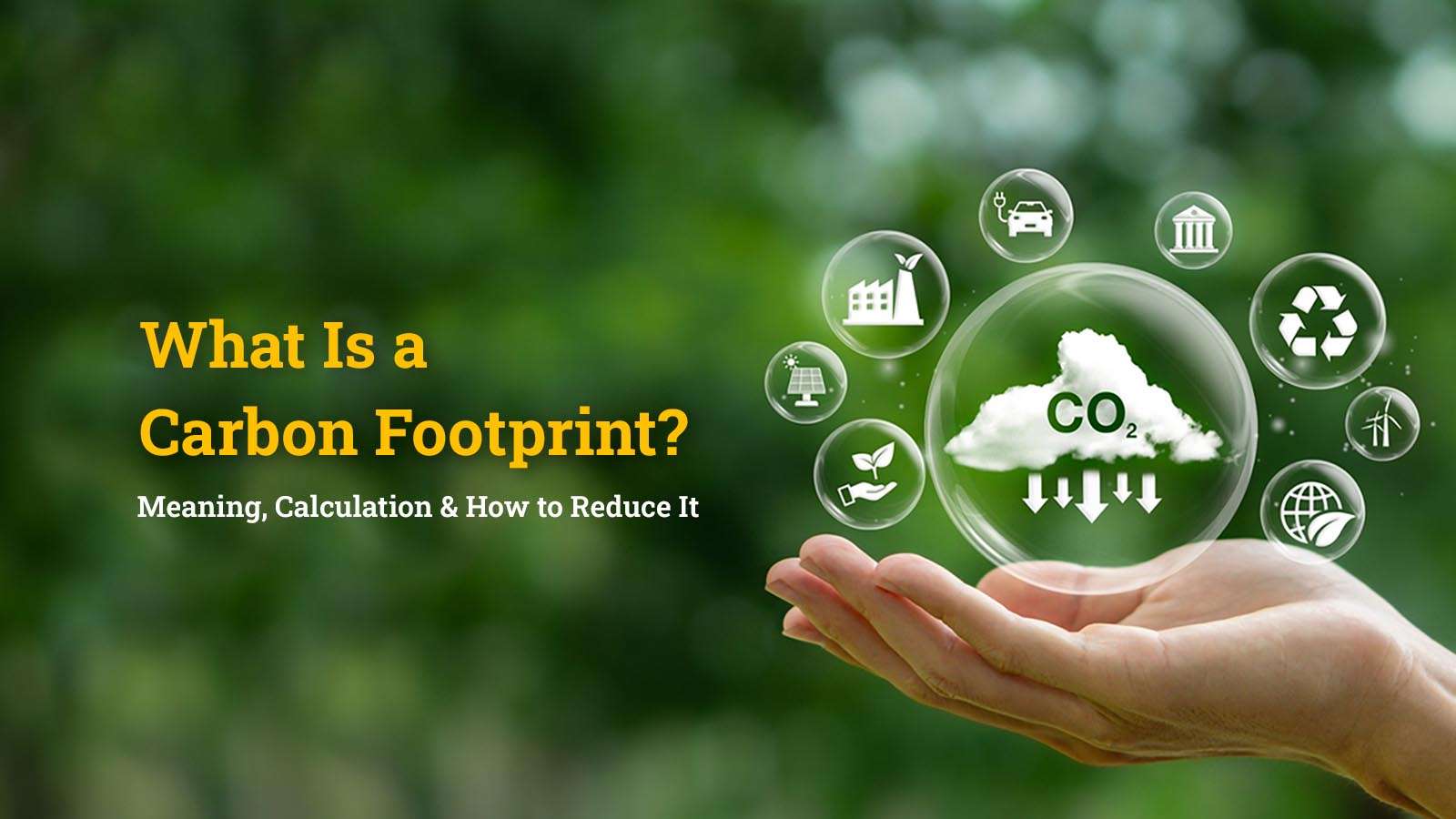
A carbon footprint is the cumulative emissions of greenhouse gases (GHGs, in CO2e) emitted to the atmosphere by an individual, product, organisation or activity. The world average is about 4 tonnes of CO2e per person per year, and to reach climate stability, this value needs to be reduced to about 2 tonnes.
The first step in minimizing both personal and corporate environmental footprints is to learn about what is a carbon footprint. The meaning of carbon footprint, its distinction from the overall emissions, the basic formulas for calculating carbon footprints, emissions Scope 1, 2 and 3, common examples of carbon footprint and how to reduce carbon footprint; both personal and your company.
What Is a Carbon Footprint?
The carbon footprint can be thought of as the human “accounting book” of all the emissions caused by our use of the planet. The formal definition of carbon footprint is the sum of all carbon emissions from our direct and indirect activities.
Quick Facts: Carbon Footprint Basics
- Measured in: Carbon Dioxide Equivalent (CO2e)
- Primary Gases Covered: Carbon Dioxide (CO2), Methane (CH4), Nitrous Oxide (N2O), Fluorinated Gases
- Useful for: People, every day products, businesses, events and whole nations
By understanding what is a carbon footprint, people and businesses can begin to see that their consumption and actions from their purchases to their trips to their actions have an “invisible” impact on the environment.
Carbon Footprint vs Greenhouse Gas Emissions
Did you know that carbon footprint is not greenhouse gas emissions(GHGs)? Let’s look at carbon footprint vs ecological footprint or more rightly said carbon footprint vs carbon emissions. There’s a distinction between carbon footprint and greenhouse gas emissions, although they are often confused. Greenhouse gas emissions are emissions that finally reach the atmosphere: Carbon Dioxide (CO2e ), Methane (CH4 ), Nitrous Oxide (N2O) and Fluorinated gases (F-gases).
These combined emissions are measured and summed up in the standardized measure of a carbon footprint. The tool that scientists use to compare the ability of each gas that traps heat in the atmosphere, in order to create a common unit called the Carbon Dioxide Equivalent (CO2 e) is the Global Warming Potential (GWP).
Carbon Footprint and Net Zero: What It Means
Net zero carbon emissions means minimizing as much as possible the output of GHGs from all aspects of the business, through actions to offset the unavoidable emissions with permanent carbon removals certified to offset the emissions.
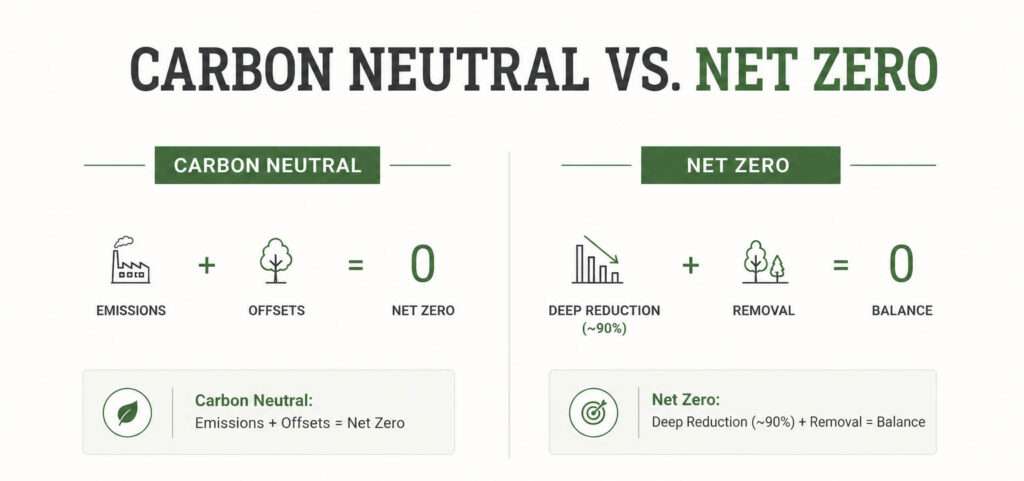
It is important to keep in mind the difference between carbon neutrality and net zero carbon emissions to reduce carbon emissions.
- Carbon Neutrality, allows entities to lower their baseline emission, and relies on third parties to balance for their current emissions.
- Residual emissions can only be neutralized after high structural reductions (typically, 90% or more) throughout the value chain have been achieved.
For example, India has set the target for its Net zero carbon emissions by 2070. The first, most essential step in the science-based target path towards true alignment with the Net Zero is the accurate science-based measurement of a baseline carbon footprint.
How to Reduce Your Carbon Footprint
Addressing the challenges of how to reduce carbon footprint in practical ways means there is a need to take specific action at individual and organisational level to effectively find ways to reduce carbon footprint.
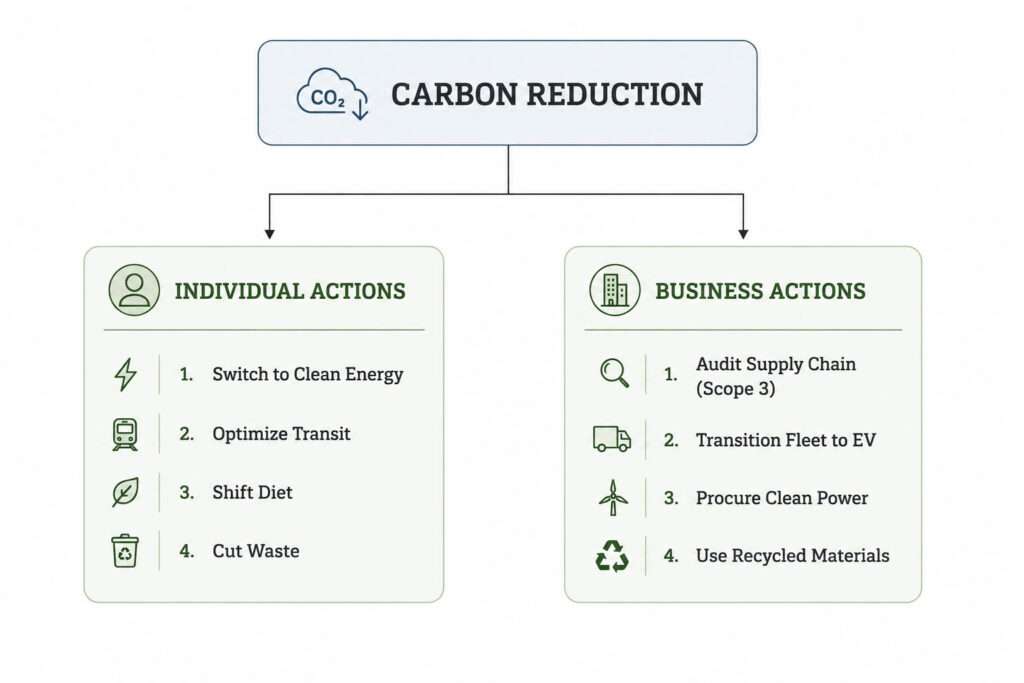
Personal Actions
In order to reduce Personal carbon footprint,
- Make the switch to clean energy: Switch home electricity to solar panels or green power tariff.
- Optimize daily travel: use public transportation, cycling, EV or car pool.
- Increase the amount of plants in the diet: Reduce high emission foods such as red meat and dairy.
- Reduce household waste: Avoid single-use plastics, compost waste or repair items.
Business Actions
- Audit supply chains: Use a Scope 3 assessment to identify hot spots in the supply chain.
- Phase out industrial vehicles: Substitute petrol driven vehicles with commercial electric vehicles.
- Buy renewable energy: corporate PPA or onsite solar.
- Substitute virgin petrochemical feedstocks with high purity recycled polymers in order to reduce the business carbon footprint.
How Is a Carbon Footprint Calculated?
Understanding how is carbon footprint calculated comes down to a straightforward baseline mathematical formula:
Activity Data × Emission Factor = Carbon Footprint (CO2e)
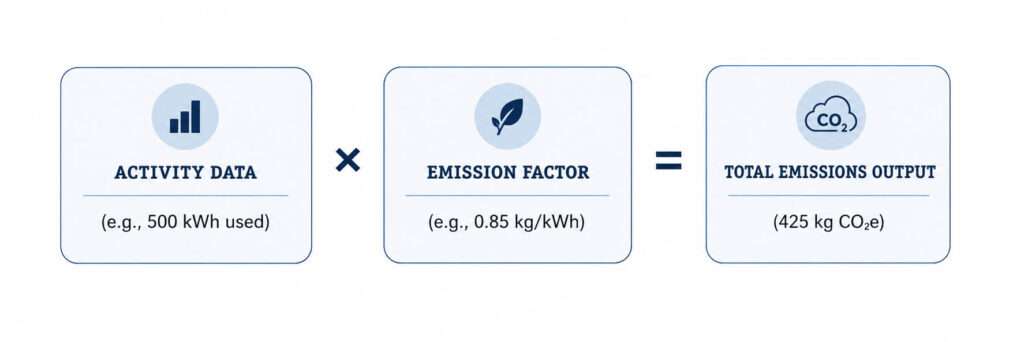
Worked Calculation Example
If an office facility consumes 500 kWh of grid electricity in a month, and the regional grid emission factor is 0.85 kg CO2e per kWh:
500 kWh × 0.85 kg CO2e/kWh = 425 kg CO2e
On how is carbon footprint calculated, have standard accounting frameworks such as the GHG Protocol, utilize localized emission factor databases and enterprise software tools to automate calculations across complex global supply chains.
Carbon Footprint Examples (Everyday & Product)
Looking at real-life carbon footprint examples provides a sense of how each action you take and every product you use contributes to emissions:
- One-Way Economy Flight (London to New York): ∼820 kg CO₂e per passenger
- Serving of Beef (100g): ∼50kg CO2e (land clearance and enteric fermentation)
- Use of one iPhone: ∼94 kg CO2 (80% electricity consumption)
- Standard 500mL Virgin Plastic Bottle: ∼82g CO2 e / unit
These numbers speak for themselves when it comes to how is carbon footprint calculated, and when it comes to how to reduce carbon footprint and the impact of everyday products’ carbon footprint, it’s very important to take a look at carbon footprint examples, raw materials and the decisions made about their carbon footprint in manufacturing.
Product Carbon Footprint & the Role of Materials
To measure a product’s carbon footprint, emissions over a product’s “cradle to grave” must be assessed, from the origin until the product is processed for its “grave”.
Typical manufacturing processes involve sourcing raw materials, which can often be the highest proportion of Scope 3 supply chain emissions. For instance, the product’s carbon footprint of manufacture shows that synthetic polymers prepared from refined crude oil are carbon heavy. This reduces the total carbon emissions of manufacturing companies by decreasing carbon inputs into its creation of plastics, a change that also improves the carbon footprint of Sustainable Packaging Solutions and structural materials.
Scope 1, 2 & 3 Emissions Explained
The Corporate Value Chain Standard categorizes into three distinct tiers;Scope 1, Scope 2, Scope 3 emissions to help organizations structure their carbon accounts effectively:
Scope Category | Operational Coverage | Practical Examples |
Scope 1 (Direct) | Onsite emissions from owned or controlled assets | Company vehicles, industrial natural gas boilers, onsite generators |
Scope 2 (Indirect) | Indirect emissions from purchased energy sources | Purchased grid electricity, district heating, steam, and cooling |
Scope 3 (Value Chain) | Indirect emissions across upstream and downstream activities | Purchased raw materials, freight logistics, product use, end-of-life disposal |
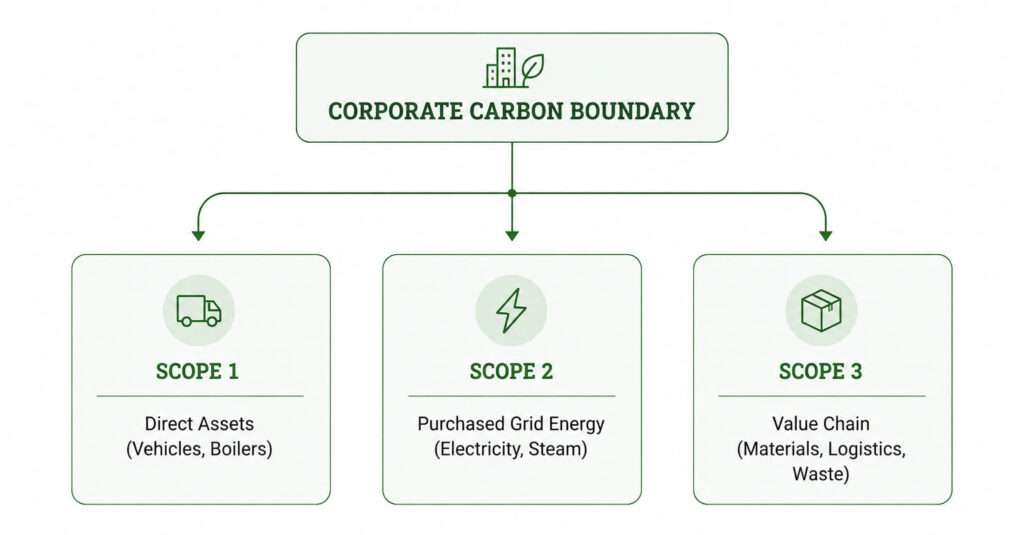
In most cases for consumer brands and industrial manufacturers measure product;s carbon emission out of Scope 1, Scope 2, Scope 3 emissions. Scope 3 emissions make up more than 80% of their overall carbon footprint. This means maximising supply chain input optimisation and minimising the carbon footprint of raw materials are the best available levers for making meaningful carbon reductions.
Shrinking Your Carbon Footprint with Recycled Plastics: Banyan Nation
To achieve embedded Scope 3 emissions, the use of high-carbon raw materials needs to be replaced by sustainable alternatives. Throughout the entire world of manufacturing, petroleum-based polymer production is a significant source of carbon emissions from industry.
At Banyan Nation, we are committed to helping consumer brands reduce packaging carbon footprint by supplying their businesses with high-purity post-consumer recycled (PCR) resin granules. With our traceable supply chain and innovative mechanical decontamination technology, we transform post-consumer plastics into Better Plastic™: near-virgin quality PCR HDPE and PCR PP resins.
When high-grade PCR resins are used in high-speed blow-molding and injection-molding lines, brands can reduce raw material emissions up to 80% compared to virgin polymer from petrochemicals. By using certified secondary resins, companies can meet Extended Producer Responsibility (EPR) requirements, reduce Scope 3 carbon intensity, and establish a sustainable manufacturing system.
FAQ's
What is a carbon footprint in simple words?
Carbon Footprint meaning or carbon footprint definition is the overall quantity of carbon dioxide equivalents (CO2 e) emitted due to our activities, our purchasing and our everyday lives.
What is the difference between a carbon footprint and a carbon emission?
The difference between a carbon footprint and a carbon emission is one of the aspects that are often confused.
Carbon emissions: The quantity of greenhouse gas (GHG) emitted as solid particles. A carbon footprint is a total measurement calculated, aggregated and then explicit in a standardised value as a CO2 e unit.
What is a good carbon footprint per person per year?
The average personal footprint is currently about 4 tonnes of CO2e per year. The goal of reducing a person’s impact to a sustainable level will, however, be extended to under 2 tonnes per person per year by 2050 if they are to discharge within the limits set by the Paris Agreement.
What is the difference between a carbon footprint and an ecological footprint?
A carbon footprint is a measure of the amount of greenhouse gas (GHG) emissions (CO2 e). A wider quantification measure is an ecological footprint which assesses the total call on nature by human beings, such as land use, cropland, forests, fishing areas and water-purposes.
How can businesses reduce their carbon footprint?
Renewable energy (Scope 2) switching, machine efficiency upgrades, fleet electrification (Scope 1), using post-consumer recycled materials in the supply chain of the business (Scope 3) are potential ways for reducing emissions.
Making recycled packaging the norm.
CITATIONS:
- Intergovernmental Panel on Climate Change (IPCC). Sixth Assessment Report: Mitigation of Climate Change and Global Warming Potential (GWP) Metrics.
- GHG Protocol. Corporate Value Chain (Scope 3) Accounting and Reporting Standard.
- Ministry of Environment, Forest and Climate Change. (2026). India’s Long-Term Low-Carbon Development Strategy and Net Zero 2070 Roadmap.
 International E-Waste Day 2026: What It Means and How to Take Part
 What is Waste Disposal: Methods, Types, and Real-World Examples
 What Is Polyolefin? Types, Properties, Uses and Recyclability
 World Rivers Day 2026: Date, Theme, History and How to Take Part
 Zero Emissions Day 2026: What It Is, Why 21 September and How to Take Part