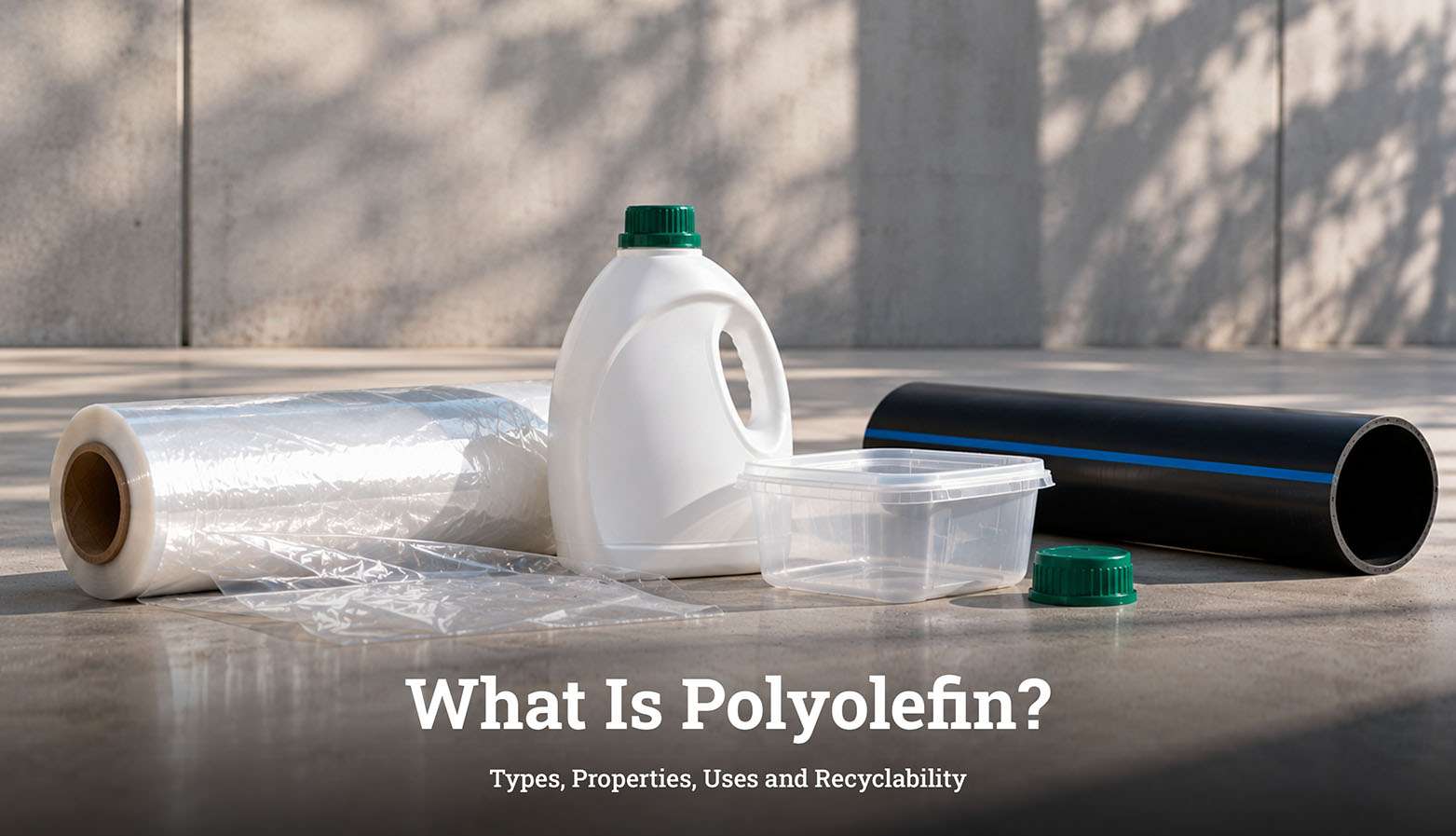
The polymer obtained by polymerisation of simple olefins (ethylene or propylene) is known as polyolefin and the compound used to make it is a chain of hydrocarbons with all possible carbon and hydrogen atoms. Polyethylene (PE) and Polypropylene (PP) are the most important branches of this family of versatile thermoplastics, being the largest family of thermoplastics in the world.What is a polyolefin materials? Polyolefin materials are ubiquitous in the packaging, agriculture, healthcare, car and consumer goods industries, as the low density, inert chemical properties, moisture barrier and the economical processing are considered.
These polymers are found in industries such asPackaging, Automotive, Irrigation, Toys, Textile, Chemicals, etc. The knowledge of molecular foundation, material properties and processing paths of polyolefin plastics is crucial for assessing the potential industrial applications and environmental impact. While historically the non-polar chemical properties of polyolefins made circular recycling difficult, modern decontamination, sorting and mechanical recycling technologies are bringing about high purity post-consumer polyolefins as secondary raw materials in a circular economy. Through this blog you will get to understand what is a polyolefin, what is polyolefin material its uses and processes of recycling of a polyolefin.
Polyolefin Meaning: The Simple Definition
Let’s first discuss what is a polyolefin and polyolefin meaning and understand polyolefin definition
Polyolefin (noun):
Plain-English: A major class of lightweight, durable thermoplastics, primarily polyethylene and polypropylene used to manufacture flexible films, rigid containers, pipes, and fabrics.
Technical: A synthetic polymer produced by the addition polymerisation of an olefin (alkene) monomer with the general chemical formula CnH2n.
Polyolefin meaning or polyolefin definition originates from the root ‘olefin’ that was used to refer to the chemicals known as alkenes, such as ethylene (C2 H4 ) and propylene (C3 H6 ), the gases from which oil is formed. These are hydrocarbons that have double bonds which can be broken to allow additional polymerisation which produces long hydrocarbon chains with only C-C and C-H bonds. So if you are wondering what is a polyolefin and polyolefin meaning, it’s just a plastic that is constructed from these basic alkene units.
What Is Polyolefin Made Of? From Ethylene to Polymer
In order to appreciate the ingredients of polyolefin, let’s examine the process of “refining” petrochemicals. It begins with fossil feedstocks (crude oil or natural gas), followed by chemical cracking to break down the feedstocks into low molecular weight monomers that are then polymerized into a solid polymer chain.
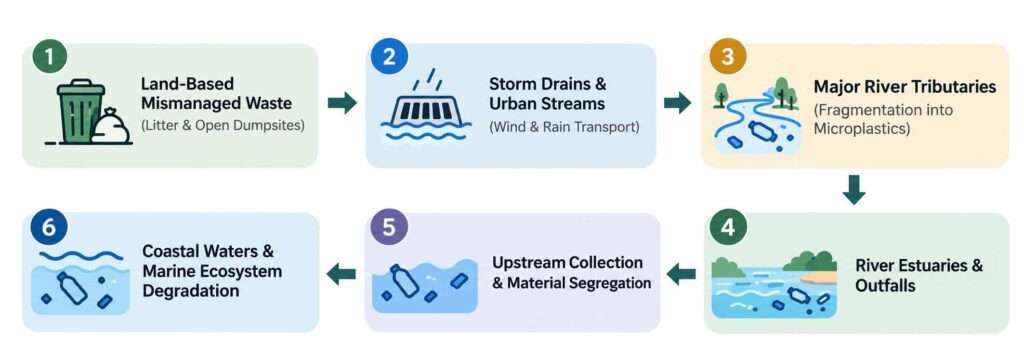
- Feedstock Extraction: Crude oil or natural gas is treated to produce light hydrocarbon products like ethane, propane or naphtha.
- Thermal Steam Cracking: Naphtha or ethane is cracked at high temperature in a thermal cracker to give simple alkene monomers like ethylene and propylene.
- Catalytic Polymerisation: The monomers are fed to the high pressure reactors containing the catalyst (Ziegler-Natta or metallocene). The catalyst enables the carbon-carbon double bond to be broken, and that thousands of monomer units become chemically joined together in sequence to create long polymer chains.
- Resin Compounding: The polyolefin resin produced is extruded, cooled, and cut into uniform plastic pellets or granules that are used in the industrial film extrusion, injection molding or blow molding processes.
Types of Polyolefin: HDPE, LDPE, LLDPE, PP
There are different types of polyolefin. The molecular branching and density of the polyolefin material has a direct influence on the physical behavior of the material. There are two types of packing applications which are primary and secondary. Primary packaging includes food packaging, non-food packaging, automotive, textile, etc. Secondary packaging includes flow wrap, shrink films, poly bags, liners, stretch films, VCI bags, etc.
The major classes of polyolefin resin used in different industrial/commercial applications are shown in the table below:
Type | Full Name | Density (g/cm3) | Key Property | Typical Products | Resin Identification Code |
HDPE | High-Density Polyethylene | 0.941−0.965 | High stiffness, tensile strength, and chemical resistance | Milk jugs, shampoo bottles, detergent tubs, piping | #2 |
LDPE | Low-Density Polyethylene | 0.910−0.925 | High flexibility, transparency, and impact resistance | Squeeze bottles, trash bags, bread bags | #4 |
LLDPE | Linear Low-Density Polyethylene | 0.915−0.930 | High puncture resistance and tear strength | Stretch wrap, agricultural films, heavy-duty sacks | #4 |
PP | Polypropylene | 0.895−0.920 | High melting point, fatigue resistance, living hinge capability | Food containers, bottle caps, automotive bumpers, nonwovens | #5 |
UHMWPE | Ultra-High-Molecular-Weight PE | 0.930−0.940 | Exceptional abrasion resistance and self-lubrication | Medical implants, armor plates, industrial chute liners | #7 (Other) |
TPO | Thermoplastic Polyolefin | 0.880−0.910 | Impact modification, weatherability, elastomeric feel | Automotive dashboards, exterior trims, roofing membranes | #7 (Other) |
POE | Polyolefin Elastomer | 0.860−0.890 | Extreme flexibility, low temperature resilience | Footwear soles, wire insulation, polymer impact modifiers | #7 (Other) |
Is Polyethylene a Polyolefin? The Plastic Family Tree
Yes, polyethylene is a polyolefin – polyethylene polyolefin. Indeed, polyethylene polyolefin(PE) and polypropylene (PP) are the two cornerstones of the entire family of polyolefins. To appreciate the polyethylene polyolefin relationship, it’s helpful to view the commercial polymers classification tree:
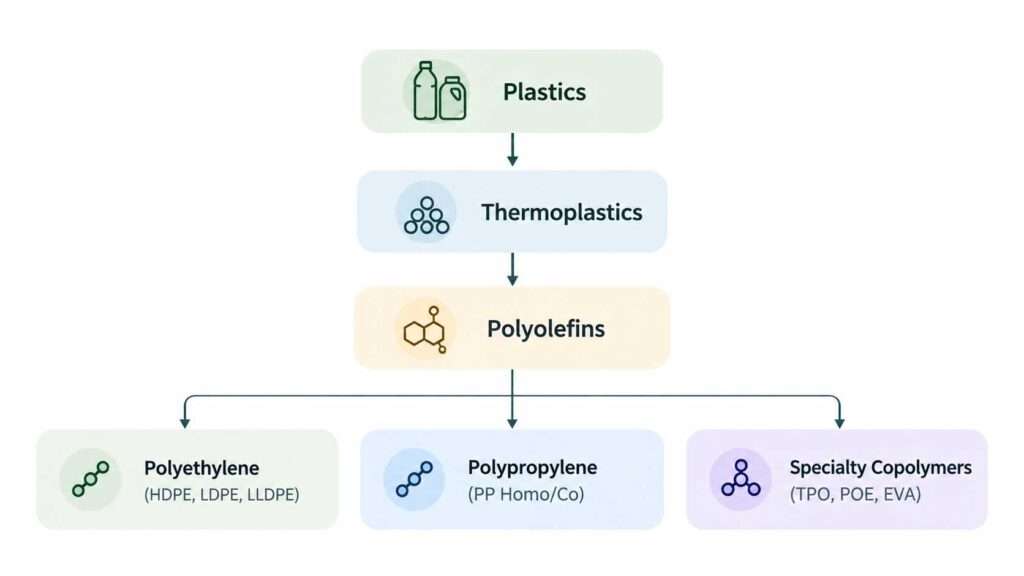
Since polyethylene polyolefin is formed from the addition of CH2=CH2 (ethylene) to its end groups, it meets all of the chemical requirements for a polyolefin.
Polyolefin Properties: Why It Dominates Plastic Packaging
Polyolefin plastic’s ability to combine its physical, chemical and economical properties makes it widely used in global supply chains.
Physical / Chemical Property | Typical Value / Behavior | Industrial Advantage |
Specific Density | 0.89−0.965 g/cm3 | Exceptionally lightweight; floats on water (facilitating float-sink recycling) |
Melting Point (Tm) | PE: 105∘C−135∘C | PP: $160^\circ\text{C} – 165^\circ\text{C | Low energy processing for PE; high thermal tolerance for PP hot-fill packaging |
Chemical Resistance | Immune to dilute acids, alkalis, alcohols, and aqueous salts | Excellent for chemical storage, detergent packaging, and industrial piping |
Moisture Absorption | <0.01% over 24 hours | Prevents moisture ingress; preserves food freshness and protects electronics |
Electrical Insulation | High dielectric strength (>20 kV/mm) | Ideal material for wire jacket insulation and electrical cable jacketing |
Combined with low raw material cost and high moldability, these properties make polyolefins the material of choice for single-use and durable goods alike. Now let’s see in depth what is polyolefin material
Where Polyolefin Is Used: Packaging, Pipes, Auto and Textiles
When considering the uses of polyolefin material or polyolefin plastic, the products are used in almost every manufacturing industry:
Flexible Packaging and Films
- Films for food packaging with high clarity and bread bags (LDPE/LLDPE)
- Industrial stretch wrap and protective bubble wrap are not biodegradable and will not bio-degrade.
- Heavy duty agricultural greenhouse cover and mulch film.
Rigid Containers and Closures
- Blow-molded milk jugs, detergent bottles, pharmaceutical bottles (HDPE)
- Food tubs, microwave containers, caps (PP)
- Industrial crates, storage boxes, chemical drums.
Water and Gas Piping Systems
- High-pressure potable water distribution networks (HDPE 100 pipes)
- Natural gas pipes that are underground and drip irrigation tubing for agriculture.
- Sewers and drainage pipes, corrugated or slated.
Automotive Interiors and Exteriors
- Vehicle bumpers, fascia panels and engine bay covers (TPO/PP)
- Door panel trims, battery cases, and dashboard substrates.
- The carpet backing and acoustic insulation inside the carpet.
Nonwovens and Synthetic Fabrics
- Disposable surgical gowns, face mask and medical drapes (Spunbond/Meltblown PP).
- Diaper top-sheets and sanitary product liners of hygienic materials
- Outdoor upholstery fabrics (polyolefin fabric) that are resistant to the elements and marine carpeting.
Polyolefin vs PET, PVC and PS: How They Differ
Polyolefins are often mistaken for other common commercial thermoplastics by many consumers. Polymers such as PET (Polyethylene Terephthalate), PVC (Polyvinyl Chloride), and PS (Polystyrene) have entirely different chemical backbone structures, however.
Polymer | Resin Code | Density (g/cm3) | Food-Safe | Recyclability | Key Structural Difference | Primary Use |
HDPE / PP (Polyolefin) | #2, #5 | <0.965 | Yes | High | Carbon-Hydrogen backbone only | Milk jugs, caps, tubs, pipes |
PET | #1 | ∼1.38 | Yes | High | Contains ester groups and aromatic rings | Water/soda bottles, thermoform trays |
PVC | #3 | ∼1.40 | Conditional | Low | Contains chlorine atoms (Cl) | Plumbing pipes, vinyl siding, medical tubing |
PS | #6 | ∼1.05 | Conditional | Low | Contains pendant benzene rings | Disposable cutlery, expanded foam packaging |
Note: PET is not a polyolefin because its polymer chain contains oxygen and aromatic ester linkages rather than a pure hydrocarbon chain.
Polyolefin Fabric and Polyolefin Shrink Film: Two Special Cases
Most search queries are centered around two particular industrial uses of polyolefin materials:
Polyolefin Fabric
Olefin fiber or polyolefin fabric is continuous fiber made from a material of polypropylene or polyethylene, extruded through a spinneret. The fibres produced are hydrophobic, resistant to stains, colourfast, mould and chemical resistant, and are used in the production of outdoor patio furniture upholstery, automotive interior carpets, geotextile soil stabilizers and protective medical apparel.
Polyolefin Shrink Film
Polyolefin shrink film (POF) is a multi-layer co-extruded shrink film which is usually composed of PE and PP copolymers. Due to its high clarity, strength, non-toxic incineration profile and safety compliance with the food-contact regulations, it has been replacing the use of PVC shrink film in many areas. Food trays, books, cosmetics and retail products are wrapped in the shrink film which shrinks tightly when heated.
Is Polyolefin Recyclable? Resin Codes 2, 4 and 5 Explained
It is possible to mechanically recycle polyolefins to 100%. Polyolefins belong to thermoplastics which are polymers that can be melted, molded and solidified many times without catastrophic degradation as compared to thermoset polymers.
Resin Identification Code | Polymer | Typical Recyclability Status in Municipal Streams |
Resin Code #2 | High-Density Polyethylene (HDPE) | Widely Recycled: Collected extensively across municipal curbside systems worldwide |
Resin Code #4 | Low-Density Polyethylene (LDPE/LLDPE) | Moderately Recycled: Rigid forms accepted; flexible film streams require specialized collection |
Resin Code #5 | Polypropylene (PP) | Increasingly Recycled: Widely accepted in curbside programs for tubs, trays, and closures |
Along with PET (#1), the most valuable and most recycled streams of post consumer plastics in India and globally are rigid HDPE (#2) and PP (#5).
Why Recycling Polyolefins Is Hard – and How It Is Solved
Consequently, chemically challenging at scale processing of post-consumer polyolefins:
- During float-sink separation, both PE (∼0.95 g/cm3) and PP (∼0.90 g/cm3) float in water (1.0 g/cm3). The separation of polyolefins from other heavier plastics like PET or PVC is easier using a conventional float-sink tank, but separating PE from PP is more complex and demands more high-tech Near-InfraRed (NIR) optical sorting.
- Thermal Degradation & Polymer cross-contamination: PP in an HDPE recycling stream is enough to impact the final product by embrittling it.
- Unpleasant odours and variable colour profiles in recycled pellets are the result of post-consumer polyolefins being contaminated by volatile organic compounds (VOCs) from detergents, milk and food residues.
Modern Technical Solutions
Modern mechanical recycling facilities achieve optimal separation of PE/PP in the presence of contamination by combining high-resolution NIR optical sorters, intensive hot-wash friction friction modules, vacuum degassing extruders and advanced melt-filtration systems.
Recycled Polyolefins: What rPE and rPP Can Actually Replace
rPP is not part of a circular economy loop in most cases. Mechanically advanced recycled polyethylene (rPE) and recycled polypropylene (rPP). Although it carries recycling symbol 5, MFI in packaging applications ranges from fractional to 45. When specific MFI and colour are required at resin level, yield losses are significant, limiting true circularity. rPP can, however, be upcycled or downcycled once collected.
- The areas where Recycled Polyolefins excel are in non-food packaging (detergent bottles, personal care containers), automotive battery cases, drainage pipes, storage crates, and agricultural film applications.
- The direct food contact approval of 100% PCR polyolefins is still highly regulated because of the possibility for contaminant migration. With multi-layer co-extrusion technology (virgin food-safe layers between rPE/rPP layers), however, brands can safely use a high rPE content in food containers.
- rPP in multilayer packaging (e.g., BOPP tape or BOPP/PET laminates) is 100% non-recyclable mechanically, as it cannot be separated from the laminate structure.
How Banyan Nation Produces High-Quality Recycled Polyolefins
The switch from low-grade plastic downcycling to industrial-grade recycling of high purity is a vital step towards the close of the plastic pollution loop. Banyan Nation is leading India in the conversion of post-consumer polyolefins to high quality secondary raw materials.
Banyan Nation’s integrated supply chain and proprietary washing and decontamination technology results in the extraction of PE and PP post-consumer waste before it ends up in landfills or water systems. It is turned into high-purity, near-virgin quality Post-Consumer Recycled (PCR) polyolefin resin – Better Plastic™. Banyan Nation’s PCR resins enable global FMCG, automotive and industrial brands to achieve their Scope 3 emission reductions and Extended Producer Responsibility (EPR) goals without compromising on manufacturing efficiency, consistency or odour.
FAQ's
What is a polyolefin in simple words?
A polyolefin is a lightweight, versatile plastic made by linking simple hydrocarbon molecules (ethylene or propylene) into long chains. The most common examples are polyethylene (PE) and polypropylene (PP).
Is polyethylene a polyolefin?
Yes. Polyethylene is the most widely produced polyolefin in the world, synthesized by polymerising ethylene monomers.
What is polyolefin made of?
Polyolefins are synthesized from petrochemical feedstocks like crude oil or natural gas. Ethane or naphtha is cracked into ethylene or propylene gases, which are then polymerised into solid plastic resins.
Is polyolefin the same as plastic?
“Plastic” is a broad umbrella term covering all synthetic or semi-synthetic polymers. Polyolefins are a specific, major sub-family of thermoplastics that includes PE and PP. All polyolefins are plastics, but not all plastics (e.g., PET, PVC, Nylon) are polyolefins.
Is polyolefin recyclable?
Yes. Polyolefins with Resin Identification Codes #2 (HDPE), #4 (LDPE), and #5 (PP) are mechanically recyclable thermoplastics that can be melted and reformed into new products.
What is the difference between polyolefin and polyester?
In polyolefin vs polyester, polyolefins (PE, PP) are pure hydrocarbon polymers containing only carbon and hydrogen atoms, making them lightweight and hydrophobic. Polyester (such as PET) contains ester linkages with oxygen atoms in its backbone, resulting in higher density, higher melting points, and different chemical properties.
Making recycled packaging the norm.
CITATIONS:
- Peacock, A. J. (2000). Handbook of Polyethylene: Structures, Properties, and Applications. CRC Press.
- Tripathi, D. (2002). Practical Guide to Polypropylene. Smithers Rapra Technology.
- Association of Plastic Recyclers (APR). (2025). Design Guide for Polyolefin Recyclability and Sorting Mechanics.
 What Is Polyolefin? Types, Properties, Uses and Recyclability
 World Rivers Day 2026: Date, Theme, History and How to Take Part
 Zero Emissions Day 2026: What It Is, Why 21 September and How to Take Part
 World Cleanup Day 2026: Date, Theme and How You Can Take Part
 What is Polypropylene Plastic?