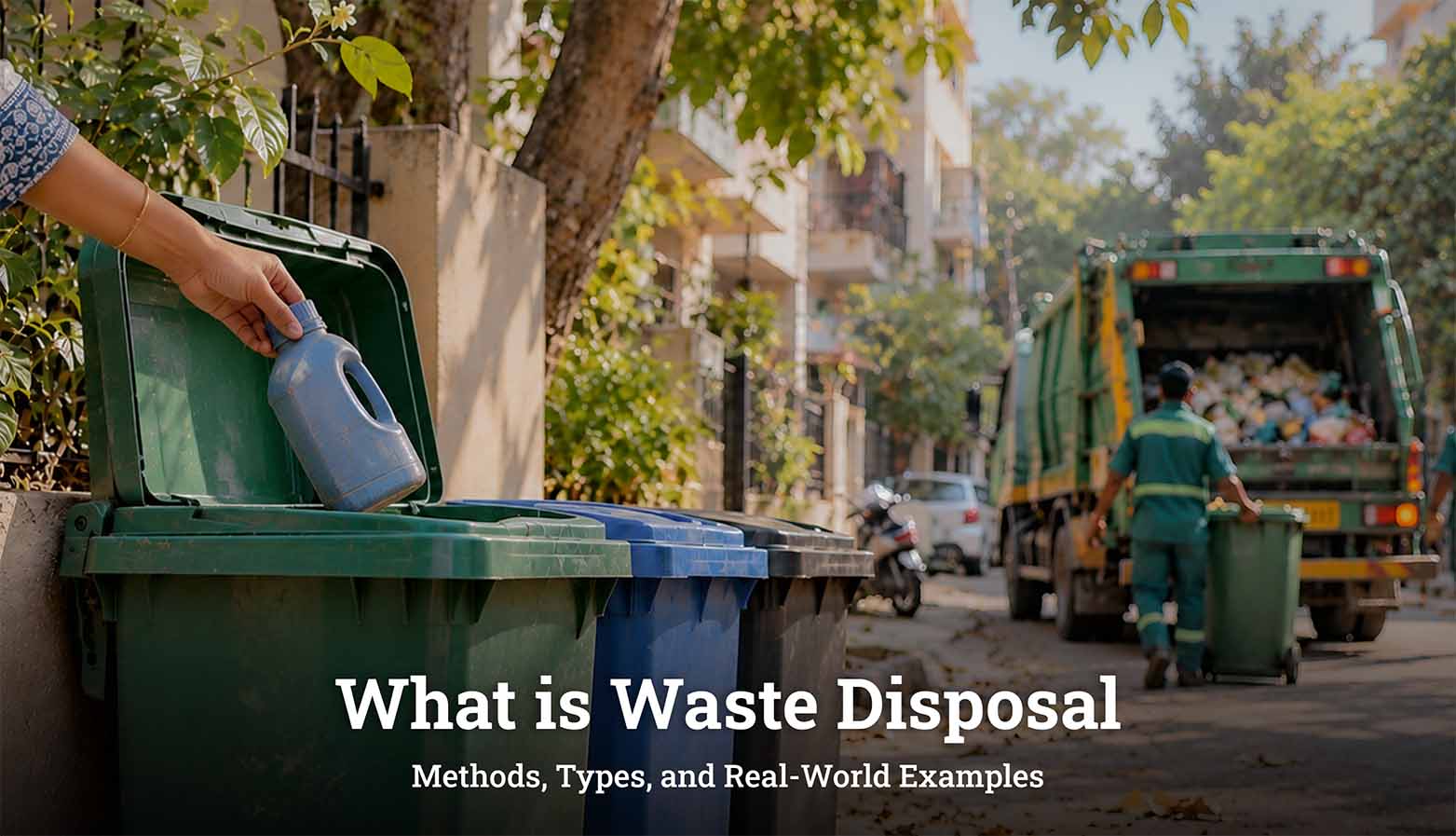
There is no single method to choose for waste disposal because the type of method depends on the waste discarded. While the priority will always be to reduce the amount of waste discarded, organic waste needs composting, rigid plastic waste belongs in the recycling loop and non-recyclables discarded in energy recovery or scientific landfilling. Understanding your options helps redirect everyday materials toward proper waste disposal methods instead of mixed garbage dumps
Which Is the Best Method of Waste Disposal?
Reducing waste generation at the source is always the best method for waste disposal because it avoids usage of resources to recover and emission entirely. When waste is unavoidable, composting serves as the best method for organic wet waste while mechanical recycling works best for rigid plastic, glass, paper and metals. Non-recyclables on the other hand require proper waste-to-energy incineration and sanitary landfills as the last resort.
The 8 Methods of Waste Disposal Explained
Every waste disposal approach comes with its own benefits and practical limitations:
1. Source Reduction
This rates as the primary and most effective way of waste reduction refusing to comply with the use of single use plastics and finding alternatives such as tote bags and concentrated refills. It reduces all the energy emission processes such as packaging, shipping and processing required by all other waste disposal methods. The primary challenge will be breaking consumer habits and redesigning production lines.
2. Closed-Loop & Mechanical Recycling
Mechanical recycling repurpose discarded plastics, paper, glass, metals into secondary raw materials through processes such as sorting, shredding, washing and extrusion. This helps to keep the material in a circular loop reducing the usage of virgin material. The execution challenges include mixed waste and organic contamination along with polymer degrading after repeated processing.
3. Biological Composting
The most common process used for organic and wet waste where aerobic composting relies on microbes to decompose the waste into nutrients and fertilizers for soil. This process is affordable and diverts organic matter but requires proper infrastructure and air flow to avoid foul odors
4. Bio-Methanation (Anaerobic Digestion)
The process of keeping organic and wet waste sealed in oxygen free tanks converting it into clean burning fuel gas and liquid organic fertilizer. Commonly applied to farm manure and waste collected in bulk, digesters require steady temperature control to stabilize and prevent bacterial fall off.
5. Waste-to-Energy (WtE) Incineration
Converts non-recyclable solid waste at extremely high temperatures to produce steam that drives electricity turbines. Popular in Scandinavian nations this effectively reduce initial waste volumes by up to 90% while heating. This requires high-cost investment and maintenance, deploying expensive scrubbers to filter toxic emissions and heavy metals before the release of hazardous fly ash which requires extra stabilization
6. Engineered Sanitary Landfills
Technology-driven burial sites are lined with thick protective clay and plastic liners to prevent leakage of toxins to the soil. Unlike open dumb yards, they contain the releasing of methane and other toxins while consuming vast areas of land and demanding constant monitoring
7. Plasma Gasification
Employs intense electrical arcs to shred trash at the molecular level, converting carbon compounds into syngas and melting inorganics into inert slag. It safely neutralizes hazardous materials, but extreme energy consumption keeps costs prohibitive for regular city trash.
8. Ocean Dumping (Why It Is Internationally Banned)
Ocean dumping of waste was used by coastal cities for years to dispose of industrial and municipal solid waste. This process is completely banned in most countries due to the ecological devastation it causes. Dumping of waste causes destruction of coral reefs and leakage of microplastics into all marine food webs. This will eventually arise as the major reason for increasing global temperature and microplastics that re-entering human food supplies.
Best Disposal Method by Waste Type
Pairing waste streams with improper disposal channels affects resources. The table below outlines appropriate disposal pathways:
Waste Stream | Best Option | Why It Works | What to Avoid |
Food Waste | Composting / Biogas | Recovers clean soil nutrients or usable bioenergy. | Landfilling: Buried food rots anaerobically, emitting potent methane. |
Rigid Plastics | Mechanical Recycling | Keeps petroleum-based polymers circulating in the economy. | Open burning: Discharges carcinogenic fumes into neighbourhood air. |
Paper & Cardboard | Repulping | Conserves trees; Natural Fibers can be reused 5 to 7 times. | Wet bins: Moisture triggers fiber rot, making recovery completely impossible. |
Glass Containers | Remanufacturing | Glass can be melted repeatedly with zero loss in chemical strength. | Trash burial: Glass never breaks down in landfills. |
Scrap Metals | Secondary Smelting | Saves up to 95% of the power required to extract virgin ore. | Mixed disposal: Difficult to pull out once buried; corrodes in acidic soils. |
E-Waste | Certified Recyclers | Safely recovers gold, copper, and silver while trapping lead. | Acid leaching: Informal scrapping poisons regional soils and water. |
Sanitary Waste | High-Heat Incineration | Destroys pathogens and denatures hazardous biomatter. | Compost bins: Spreads dangerous disease vectors. |
C&D Rubble | Crushing & Screening | Recovers sands and aggregates for base layers and roads. | Vacant lot dumping: Blocks municipal drainage networks. |
Chemicals / Paint | Chemical Treatment | Neutralizes toxic properties to stop chemical leaching. | Sink drains: Permanently contaminates public drinking water tables. |
Medical Waste | Autoclaving | Sterilizes equipment using pressurized medical steam. | General trash: Exposes sanitation teams to contaminated sharp objects. |
The Waste Management Process, Step by Step
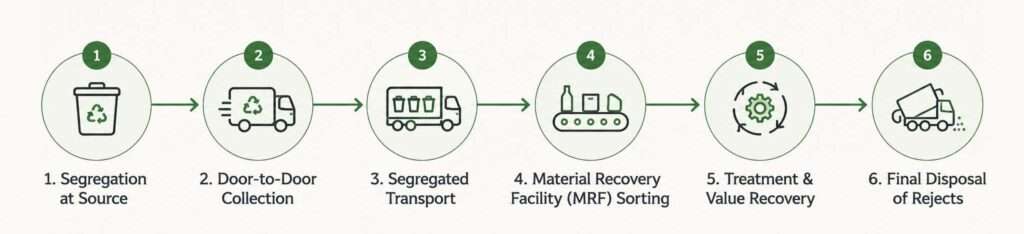
Step 1: Segregation at Source
Segregating waste at home to different categories to avoid mixing of waste before providing it to the collection team.
Step 2: Door-to-Door Collection
The waste collection team comes to your doorsteps on designated dates collecting segregated waste to prevent mixed waste contamination.
Step 3: Segregated Transport
Compartmentalized, GPS-tracked vehicles transfer wet, dry, and hazardous fractions separately to avoid contamination and provide transparency.
Step 4: Sorting at Material Recovery Facilities (MRF)
Facility dedicated to classifying secondary sorting of the materials, segregating the dry waste according to recyclability and polymers.
Step 5: Treatment & Processing
Specialized processing units which derive value or solutions to the segregated wastes using methods such as biological, mechanical, chemical, or thermal pathways.
Step 6: Final Disposal of Rejects
Only non-recyclable, non-combustible, and non-reactive waste collected are deposited into double-lined, engineered landfills.
Sustainable Waste Disposal Methods: What Actually Lowers Emissions
Findings highlighted by the MIT Climate Portal confirm that reducing waste generation at source is the only effective strategy across every product category. Recycling helps to lower the industrial emission and virgin production, but it always depends on the quality of raw materials considering the cleaning and washing footprint. Organic waste diversion becomes vital as the chances of poisonous methane gas emission from landfill is inevitable if not supervised efficiently.
Waste Treatment Methods: Physical, Chemical, Biological, and Thermal
The sustainability discussions often closely identify waste treatment methods and final waste disposal. Waste treatment completely transforms the physical, chemical, or biological character of the materials, helping to reduce the volume, reduce toxicity, and recover valuable assets for repurposing. Waste disposal in contrast focuses on the end of the life of a product where no further value is created from the material.
Physical Treatment
The material goes through an altering process of size and shape of raw materials without changing the chemical properties. Shredding, compacting, magnetic segregation and optical sorting at MRFs are the common techniques used
Chemical Treatment
Chemical reactions are used to neutralize hazardous properties, precipitate toxic heavy metals out of industrial effluents, or adjust pH levels through acid-base neutralization and oxidation.
Biological Treatment
Organic properties are metabolized under controlled environmental conditions by microorganisms. Aerobic composting and anaerobic bio-methanation naturally transform unstable putrescible organics into stabilized soil amendments.
Thermal Treatment
At very high temperatures, both chemical and physical properties of the raw materials are altered. Techniques like combustion, gasification, pyrolysis, and autoclaving reduce waste volumes by up to 90% while recovering thermal energy.
Waste Collection Methods: Kerbside, Community Bin, and Door-to-Door
Urban infrastructure relies on tailored pickup systems to maintain material purity:
- Kerbside Pickup: Labelled bins with wheels are kept along the streets in residences where mechanical waste collecting trucks comes and pick up the trash separately emptying the bins
- Door-to-Door Pickup: Waste collection is implemented by sanitary workers approaching each household collecting segregated waste according to schedule.
- Community Drop Bins: Mostly in gated communities and neighbourhoods, residents deposit segregated waste in bulk for waste collectors to pick up
- Segregated ULB Fleets: Modern Urban Local Bodies (ULBs) deploy purpose-built light commercial vehicles equipped with split compartments and audio reminders to prevent clean dry recyclables from mixing with wet organic discards
India’s Solid Waste Management Rules 2026: What Changed?
The Ministry of Environment, Forest and Climate Change notified the Solid Waste Management Rules, 2026, superseding the outdated 2016 framework. These updated rules move solid waste administration from informal guidelines to a strict, audit-driven compliance system:
Mandatory Four-Stream Segregation
Replaces the basic wet-and-dry system with four mandatory streams at source: Wet Waste, Dry Waste, Sanitary Waste (diapers, pads, securely wrapped), and Special-Care Waste (household hazardous goods like paints, batteries, CFLs, and expired medicines).
Instructions for Bulk Waste Generator (BWG
Enforces strict compliance on commercial buildings of or above 20,000 square metrics, facilities consuming 40,000 liters or more of water daily, or any facility generating over 100 kg of solid waste per day.
Extended Bulk Waste Generator Responsibility (EBWGR)
Similar to packaging EPR, bulk generators unable to process wet fractions on-site must purchase verified EBWGR certificates, internalizing treatment liabilities.
Polluter-Pays Penalties
Municipalities should impose immediate financial penalties and environment compensation for unauthorized dumping and promoting unsegregated waste collection.
Mandatory Refuse-Derived Fuel (RDF) Offtake
Cement kilns and industrial boilers must substitute a share of fossil fuels with non-recyclable combustible refuse.
Waste Management Techniques for Homes, Offices, and Factories
For Homes
- Separate bins are to be used for wet, dry, sanitary and hazardous waste
- Wash and clean oily/greasy food containers & bottles to avoid contamination of other materials like paper and carboard
- Install Bio Compostable Bins in balcony or surroundings to compost daily kitchen waste
- Hand used batteries and electronics directly to authorized take-back centres.
For Offices
- Install Multi Bins sorting hub replacing personal trash cans for every
- Reduce the use of single use cups, straws, plates and swap with reusable ceramic and glass products.
- Let the old e-waste such as computers and other electronic items be disposed of responsibly to certified collectors
For Facilities & BWGs
- Bulk generators producing over 100 kg/day must install automated on-site wet waste processing plants or organic waste converters (OWCs) to meet national rules.
- Bale clean cardboard and stretch film to sell to secondary recyclers.
- Log generation weights to track waste reduction goals and comply with bulk generator rules.
Why Segregation Decides Whether Any Method Works
Segregation at source is the most important part of resource recovery in the waste management process. When the waste streams are segregated and kept clean, there is always a high chance of value recovery eventually helping the circular economy. Sorting facilities cannot afford to wash heavily contaminated raw materials, forcing truckloads of recyclable materials into landfills. A few minutes spent segregating at source and collecting separately boosts the entire circular value chain operation.
What Happens to Segregated Plastic: Banyan Nation’s Recycling Loop
When segregated plastic reaches advanced recyclers like Banyan Nation, it bypasses landfills entirely. It is washed, decontaminated, and converted back into high-grade recycled plastic granules. Consumer brands use these circular resins instead of virgin fossil polymers to make new shampoo bottles, household goods, and automotive parts. This formal, technology-driven recovery pathway also generates verified Extended Producer Responsibility (EPR) credits, enabling brands to fulfill their regulatory obligations while eliminating ocean-bound plastic pollution.
FAQ's
Which waste disposal method is best?
Preventing waste before it starts is the best method overall. For inevitable trash, compost organic scraps, recycle clean containers, and reserve landfills as an absolute last resort.
Which method is the most eco-friendly?
Composting and anaerobic bio-methanation are the greenest routes for organic waste because they restore soil nutrients and generate clean energy without synthetic chemicals.
What is the difference between waste treatment and disposal?
Treatment alters waste to make it safer, smaller, or recyclable (such as shredding or composting). Disposal is where unrecoverable remnants are placed permanently (such as sanitary landfills).
Why are landfills considered the last option?
Landfills consume large land areas, take useful materials out of circulation, and emit high-potency methane gas if not tightly managed.
What do India's solid waste rules require from households?
Households must segregate discards into four streams (wet, dry, sanitary, and hazardous) before handing them to authorized collectors.
 What is Waste Disposal: Methods, Types, and Real-World Examples
 What Is Polyolefin? Types, Properties, Uses and Recyclability
 World Rivers Day 2026: Date, Theme, History and How to Take Part
 Zero Emissions Day 2026: What It Is, Why 21 September and How to Take Part
 World Cleanup Day 2026: Date, Theme and How You Can Take Part