
The melt flow rate is among the most important parameters in the technical realm of polymer science and industrial manufacturing to identify how a plastic resin will perform in processing. Melt flow rate in particular, is a parameter that measures how easily the melt of a thermoplastic polymer flows. It is defined as the mass of a polymer, in grams, flowing in ten minutes through a capillary of a specific diameter and length by a pressure applied via prescribed alternative gravimetric weights for alternative prescribed temperatures. When recyclers and manufacturers talk about the melt flow rate, they are, in fact, measuring the viscosity of the plastic; high melt flow rate means low viscosity (the plastic flows easily) and low melt flow rate means high viscosity (the material is thicker and harder to flow). Monitoring the melt flow rate is essential in quality monitoring in the context of plastic recycling. Since the post-consumer plastic waste is usually a mixed batch of different grades, the melt flow rate of the resultant recycled pellets must be standardized to enable them to be fed in high-speed injection molding or extrusion lines without causing mechanical failures. With careful regulation and control of the melt flow rate, companies such as Banyan Nation can come up with recycled resins that can perform just as well in terms of consistency and reliability just like virgin plastics, effectively closing the divide between waste and high-performance raw materials.
Introduction
Dynamics of polymers under heat is a key to any successful manufacturing operation. It is the melt flow properties of a resin that determine the pace of the production line up to the integrity of the final product.
In the recycling industry, it is important to control melt flow as:
- It guarantees the compatibility of dissimilar batches of recycled material.
- It assists manufacturers to tune their machines to maximize energy use.
- It is a key measure of the degradation and the molecular weight of the polymer.
What is Melt Flow Rate (MFR)?
To provide a precise melt flow rate definition, we look at it as an indirect measure of In order to give an exact definition of the melt flow rate we consider it as an indirect measure of molecular weight. Reduced melt flow rate mfr generally equates to increased molecular weight that normally is translated to enhanced mechanical properties such as impact strength.
In analyzing the calculation of melt flow rate formula, engineers refer to a standardized tool known as a Melt Flow Indexer. The melt flow rate definition is standardized according to the international standards like ASTM D1238 or ISO 1133, so that the results would be comparable between different laboratories and world supply chains.
Melt Flow Index Formula and Calculation
The result of the testing process in the form of a numeric value is the melt flow index (MFI). The technicians should always observe the melt flow index formula to attain the right calculation of the melt flow rate to consider the time and mass of the extruded polymer.
Melt flow rate formula usually takes the shape of:
MFR=t600×m
Where:
- m is the mass of the extruded material in grams.
- t = time of cut-off (sec).
- The factor to convert the result into the number of grams per 10 minutes is 600.
The calculation of melt flow rate should be done under accurate heat control because a slight variation in the heat may greatly alter the output of the melt flow index formula.
Importance of Melt Flow Rate in Plastic Recycling
Melt flow index testing is of utmost significance when recycled content is involved. In melt flow rate in the recycling processes, the objective is to make sure that the recycled resin is comparable to the processability of the virgin resin that it is supposed to be replenishing.
Melt flow index is important in the manufacture of circles because:
- Grade Matching: This is done to ensure that a recycled HDPE used in bottle blowing-molding can be used as well as virgin grade.
- Contamination Detection: During recycling, abnormal increase in melt flow rate may indicate contamination or degraded polymers.
- Process Optimization: Mfi in plastic data are used by manufacturers to control their molding machines to the right temperatures and pressures.
Lack of knowledge of mfi in plastic can lead to manufactures making brittle components or making costly short shots (where the plastic does not fill the mold to capacity).
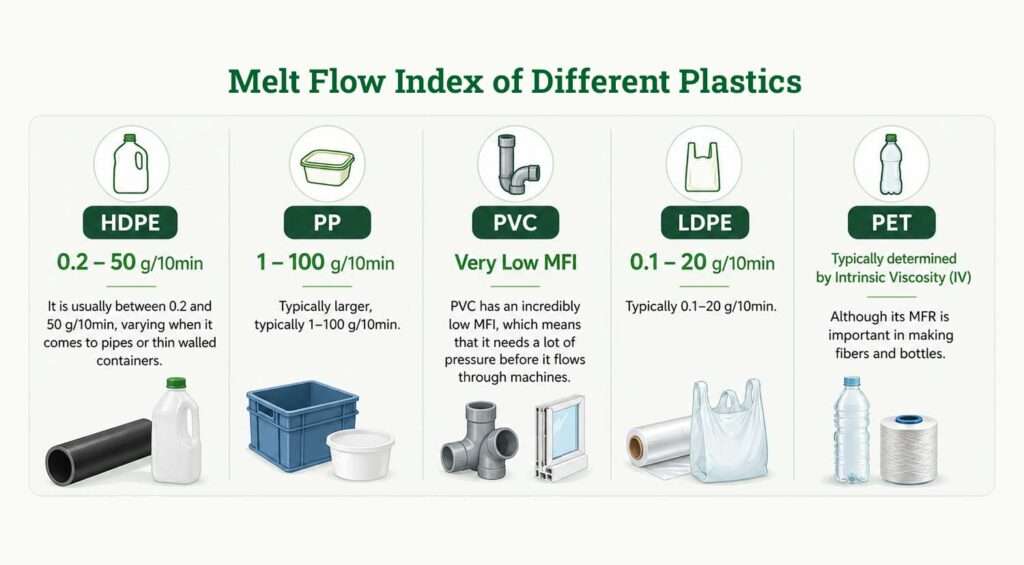
Melt Flow Index of Different Plastics
Flow signatures of different polymers differ. Recyclers can sell their materials to a particular industry through standardization of the melt flow index of hdpe or melt flow index of pp.
- Melt Flow Index of HDPE: It is usually between 0.2 and 50g/10min, varying when it comes to pipes or thin walled containers.
- Melt Flow Index of PP: Typically larger, typically 1-100 g/10min.
- PVC Melt Flow Index: PVC has an incredibly low MFI, which means that it needs a lot of pressure before it flows through machines.
- Melt Flow Index of LDPE: Typically 0.1-20 g/10min.
- PET Melt Flow Index: Typically determined by Intrinsic Viscosity (IV), although its MFR is important in making fibers and bottles.
Factors Affecting Melt Flow Rate
The calculation and importance of melt flow index in the recycling process can change due to several variables. The factors are important to understand in order to keep the importance of melt flow index standards intact.
- Molecular Weight: Bigger molecules travel slower, and this reduces the MFR.
- Temperature: The more the heat, the less the viscosity, and the higher the MFR.
- Polymer Degradation: Recycling again can ruin polymer chains resulting in an increase in MFR.
- Additives and Fillers: Glass fibers or mineral fillers may cause a substantial decrease in the flow rate.
How Melt Flow Rate Helps Improve Recycling Efficiency
Through melt flow rate monitoring in recycling, facilities are able to automate their sorting and blending process. When a batch of recycled plastic has a consistent MFR, it can be run quicker and at reduced rejects. It is this information-driven process of mfi plastic that enables contemporary recyclers to compete on the same level as the petrochemical industry.
Why Choose Banyan Nation for High-Quality Recycled Plastics
Banyan Nation has perfected the art of melt flow control. We know that to change to recycled plastic, the melt flow rate has to be perfect. Our Better Plastic melt flow rate guaranteed, mfr, to be lab tested to assure you that your injection molding or blow molding machines will run smoothly each time. By emphasizing the significance of stability in melt flow index, we assist brands to shift to a more circular model without compromising the effectiveness of the production.
Conclusion
Melt flow rate is not merely a figure but a manual of how a plastic material will be functioning in the actual world. This metric can be considered as the key to high quality plastic recycling since the formula related to the melt flow index applied in the lab well up to the melt flow rate calculation on the factory floor. By focusing on the definition of the melt flow rate, as well as testing it thoroughly, we will be able to make sure that recycled polymers will not be perceived as alternative materials, but as the primary ones to a sustainable future.
FAQ's
What is the difference between MFI and MFR?
They are often used interchangeably. Melt Flow Index (MFI) was the traditional term, whereas Melt Flow Rate (MFR)is the more modern, technically accurate term used in current international standards.
What is a good melt flow index value?
There is no “perfect” value. A “good” value depends on the application. For example, a melt flow index of hdpe around 0.5 is great for blow molding, while a value of 20 is better for injection molding.
Does higher MFI mean better plastic?
Not necessarily. A higher MFI simply means the plastic flows more easily. While this is good for filling complex molds, it often indicates a lower molecular weight, which might mean the plastic is less durable.
Making recycled packaging the norm.
CITATIONS:
- STM International. ASTM D1238 Standard Test Method for Melt Flow Rates.
- Polymer Properties Database. Melt Flow Index and Its Relation to Molecular Weight.
- ScienceDirect. Effects of Thermal Degradation on the Melt Flow Index of Recycled Polypropylene.
 What Is the Waste Disposal Hierarchy? 5 Steps Explained
 What Is ABS Plastic? Properties, Uses & Recycling
 International E-Waste Day 2026: What It Means and How to Take Part
 What is Waste Disposal: Methods, Types, and Real-World Examples
 What Is Polyolefin? Types, Properties, Uses and Recyclability