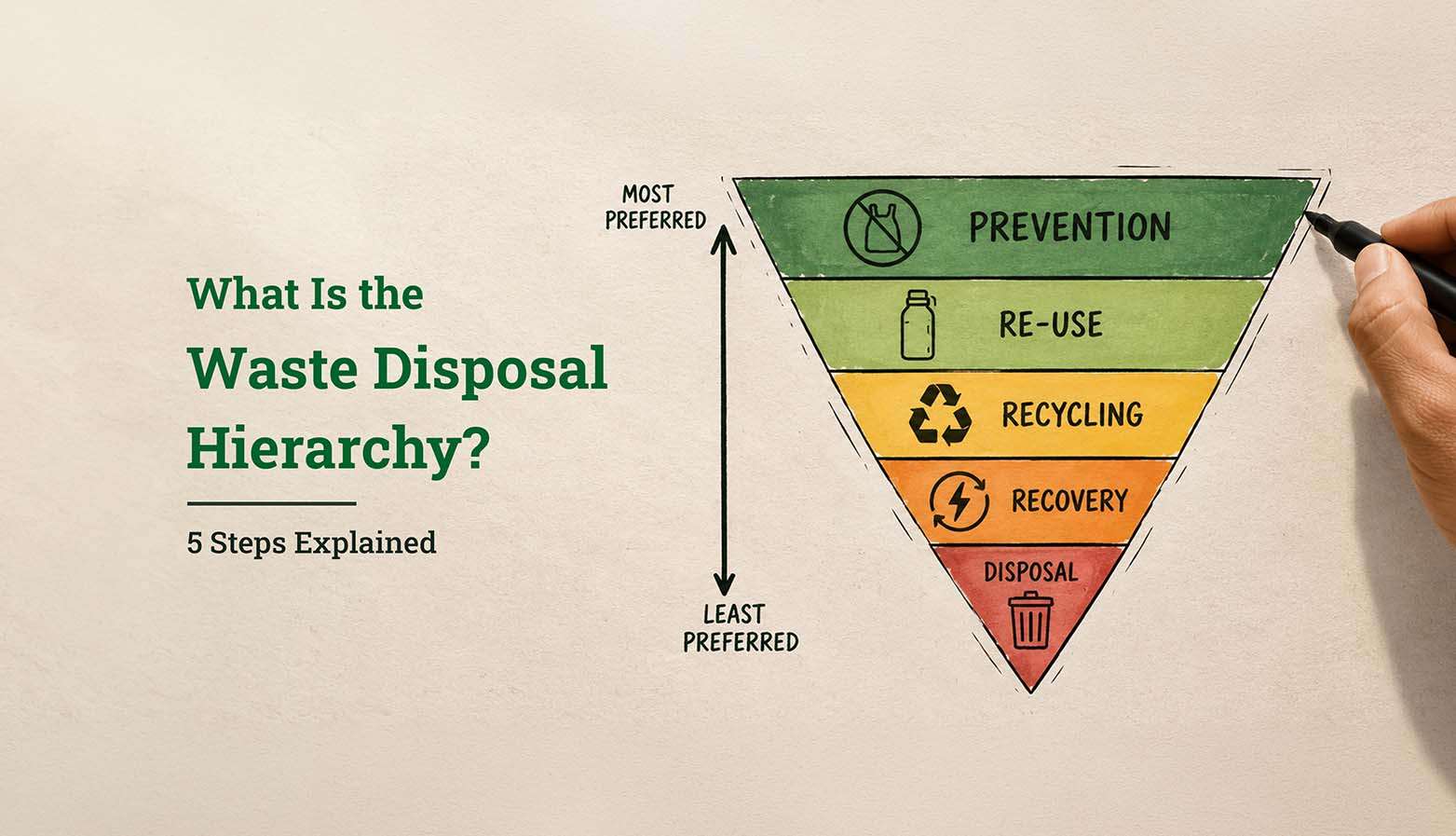
The first step in understanding what the waste hierarchy is is that not all methods of waste management are equal. The waste hierarchy is an internationally accepted approach in which waste management actions are prioritized from most preferred (prevention) to least preferred (landfilling).
What is the waste hierarchy? The waste disposal hierarchy forms the basic framework for contemporary environmental policy and serves as a handbook for cities, industry and citizens to deal with products in an environmentally sustainable way. This framework emphasises the conservation of resources at the highest level, thereby decreasing the use of virgin resources, carbon emissions and toxic pollution.
When global consumption is on the rise, it is crucial to know what is the waste management hierarchy for any business or community when thinking about moving to a circular economy. The hierarchy of waste management provides a useful guide to all decisions made on a day-to-day basis, such as at home, in industry or in the electronics sector, that contributes to long-term environmental sustainability. By learning about the 5 steps of the waste hierarchy, organisations can maximise resource efficiency and reduce their environmental impact.
Waste Management Hierarchy Meaning and Origin
In order to set the definition, let’s first understand what is the waste hierarchy? What is the waste management hierarchy?The waste management hierarchy is a prioritised system that classifies waste management possibilities by their environmental favourability with pollution prevention being placed at the top of the list.
The formal concept was established by the European Union in the groundbreaking EU Waste Framework Directive (Directive 2008/98/EC). The EU Directive legally established the 5-tier hierarchy of solid waste management, the “3Rs” (Reduce, Reuse, Recycle) principle having been promoted by environmentalists since the 1970s. It set up a guiding principle for member states and corporations that waste management decisions must be made using a resource efficiency, life cycle, and carbon mitigation approach. The framework has become the foundation of international environmental law and corporate global sustainability codes today.
What are the 5 Steps of the Waste Hierarchy?
Let’s first look into what are the 5 steps of waste hierarchy or what is waste disposal hierachy? There are five levels to the waste management hierarchy or solid waste hierarchy. Each step is a step down in environmental preference:
- Prevention (Most Preferred)
- Reuse
- Recycling
- Recovery (Energy Recovery)
- Disposal (Least Preferred)
1. Prevention (Most Preferred)
Prevention – or reduction – is concerned with preventing the generation of waste in the first place. Prevention reduces the environmental burden of extracting and processing materials before it begins, by designing fewer materials, longer-lasting products and eliminating all unnecessary packaging.
Everyday Example: Individuals purchasing loose fruits rather than plastic wrapped fruits, or a company redesigning a bottle using 20% less resin.
2. Reuse
Reuse is the reuse of an item after it has been used for its intended use but without chemical or physical reprocessing.
Everyday Example: Putting milk in a glass milk bottle, giving clothing to charity or using a strong cardboard shipping box for storage in the house.
3. Recycling
Recycling process is a process for collecting waste materials, processing them and converting into secondary raw materials and new products. The stage recovers useful materials such as plastics, paper, glass and metals from waste and prevents them from ending up in landfills.
Everyday Example: Recycling post-consumer HDPE Milk Bottles to clean plastic granules for recycled shampoo bottles.
4. Recovery (Energy Recovery)
If materials are not reusable or can not be mechanically recycled, then energy recovery is used to remove the calorific value. Waste can be turned into electricity, heat or biofuels via the processes of incineration with energy recovery, anaerobic digestion, and gasification.
Everyday Example: Waste into steam for electricity turbines in Waste-to-Energy plants, using Municipal solid waste (MSW) that is not collected for recycling.
5. Disposal (Least Preferred)
Disposal is the last of the waste management hierarchy. It covers landfill or incineration (without energy recovery). Any material put into landfill contributes to soil contamination, leaching into the ground and methane emissions, but without any value being recovered on the material.
Everyday Example: Sending mixed (unsegregated) waste directly to an open landfill dump site.
Waste Hierarchy Pyramid Diagram
What is waste disposal hierarchy or order of waste management hierarchy? The pyramid of waste shows the hierarchy of waste in an inverted pyramid. The wide base at the top is the most environmentally beneficial option (Prevention) and the narrow tip at the bottom is the last resort (Disposal).
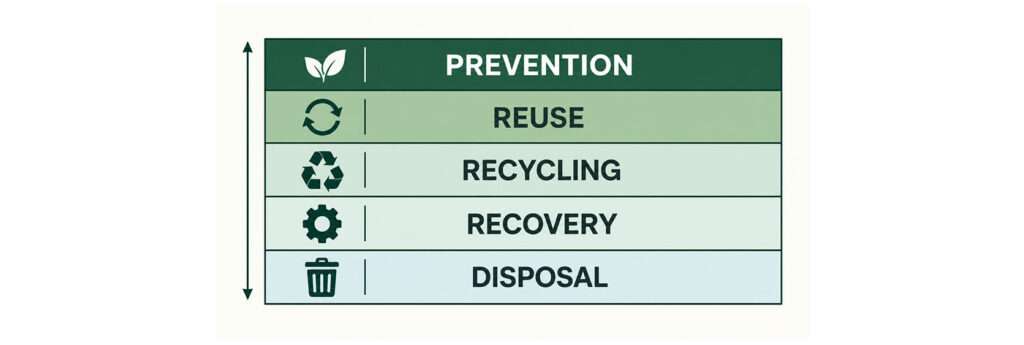
This waste hierarchy diagram conveys the message at a glance, what are the 5 steps of waste hierarchy; that most of our resource management activities should focus at the top of the pyramid to minimise the impact of our waste at the bottom of the pyramid.
Why the Waste Hierarchy Matters for the Environment
The benefits of following the hierarchy of the solid waste stream are direct ecological and economic:
- Landfill Divergence: Minimizes waste being tossed into municipal landfills, thus prolonging landfill life and the amount of harmful toxic leaching.
- Resource Preservation: Make use of the raw material that exists – prioritising secondary materials, rather than finite resources like timber, minerals and fossil fuels.
- Emissions Reduction: Reduces GHGs by removing the extraction and refining of energy intensive raw materials.
- Circular Economy Acceleration: Promotes innovation in industry to create closed-loop systems where waste is used as feed stock.
As per official environmental data, India has more than 62 million tonnes of municipal solid waste produced every year with only 30% of this waste being processed or recycled effectively, which clearly indicates the need to implement the waste disposal hierarchy in cities and industrial hubs.
Hierarchy of Solid Waste Management in India
What is waste disposal hierarchy in India?The hierarchy of solid waste management is a legal requirement in India, as per the Solid Waste Management Rules (SWM), 2016. These regulations stipulate that the waste must be segregated into waste streams for wet, dry and domestic hazardous waste, giving the legal responsibility to the waste generator to make recycling easier than landfill.
The source segregation provisions help the Indian cities to minimize the amount of mixed wastes in the dumpsites such as Ghazipur (Delhi) or Deonar (Mumbai). Formal recyclers are becoming more integrated into informal waste networks in urban centres, to maximize recovery. Find out how source separation can bring value to the material in Banyan Nation’s Comprehensive Guide to Waste Segregation.
Waste Hierarchy vs the 4Rs: What’s the Difference?
While both frameworks share the goal of sustainability, they serve different operational roles:
Feature | Waste Hierarchy | The 4Rs (Reduce, Reuse, Recycle, Recover) |
Structure | Formal, 5-tiered legal framework (EU & Global) | Simplified consumer action model |
Scope | Includes final Disposal as a defined level | Focuses strictly on positive waste actions |
Application | Policy development, EPR compliancerecycled resin granules, industrial planning | Public education and consumer habit building |
Understanding how consumer actions translate to systemic policy is explored further in Banyan Nation’s Breakdown of the 4Rs of Waste Management.
How Banyan Nation Supports the Recycling Step of the Hierarchy
At the base of the pyramid, prevention and reuse are important, but at the top of the pyramid, high purity recycling is vital to handling post-consumer plastics that cannot be prevented or reused. Banyan Nation is the key player in boosting the recycling segment in India.
Banyan Nation’s proprietary washing, sorting and compounding technology enables the recovery of post-consumer polyethylene (PE) and polypropylene (PP) before it enters the landfill or waterways. The product is processed to produce Better Plastic™—high-purity, traceable recycled resin granules that are equal to virgin plastics. The closed-loop model enables global brands to meet Extended Producer Responsibility (EPR) requirements, reduce the scope 3 emissions and replace virgin fossil plastics effortlessly. Learn how manufacturers are incorporating circular materials into their supply chain with Banyan Nation Recycled Plastics Solutions.
FAQ's
What is the most preferred option in the waste hierarchy?
The most preferred option is Prevention (or waste reduction). Avoiding the creation of waste at the product design and manufacturing stages eliminates the carbon emissions, energy usage, and environmental impacts associated with material processing and disposal.
What is the least preferred option in the waste hierarchy?
The least preferred option is Disposal (such as landfilling or incineration without energy recovery). Disposal results in the total loss of material value, consumes land resources, and risks soil, water, and atmospheric pollution.
Why is the waste hierarchy shown as an inverted pyramid?
The waste hierarchy pyramid is inverted to emphasize volume and priority. The broad top section indicates that the majority of environmental strategies should focus on prevention, reuse, and recycling, while the narrow bottom point shows that only a minimal residual fraction of waste should reach final disposal.
Is recycling better than energy recovery?
Yes. Recycling retains the physical material structure of resources so they can replace virgin raw materials in manufacturing. Energy recovery destroys the material structure to harvest heat or electricity, making it a lower-value option on the waste disposal hierarchy.
Who created the waste hierarchy?
While the concept evolved through environmental movements in the 1970s, the formal 5-step waste management hierarchy was officially defined and legally standardized by the European Union in the 2008 Waste Framework Directive (Directive 2008/98/EC).
Making recycled packaging the norm.
CITATIONS:
- European Parliament & Council. (2008). Directive 2008/98/EC on Waste (Waste Framework Directive). Official Journal of the European Union.
- Ministry of Environment, Forest and Climate Change (MoEFCC), Government of India. (2016). Solid Waste Management Rules, 2016. Gazette of India.
- United Nations Environment Programme (UNEP). (2024). Global Waste Management Outlook 2024: Beyond an Age of Waste. UNEP Publications.
 What Is the Waste Disposal Hierarchy? 5 Steps Explained
 What Is ABS Plastic? Properties, Uses & Recycling
 International E-Waste Day 2026: What It Means and How to Take Part
 What is Waste Disposal: Methods, Types, and Real-World Examples
 What Is Polyolefin? Types, Properties, Uses and Recyclability