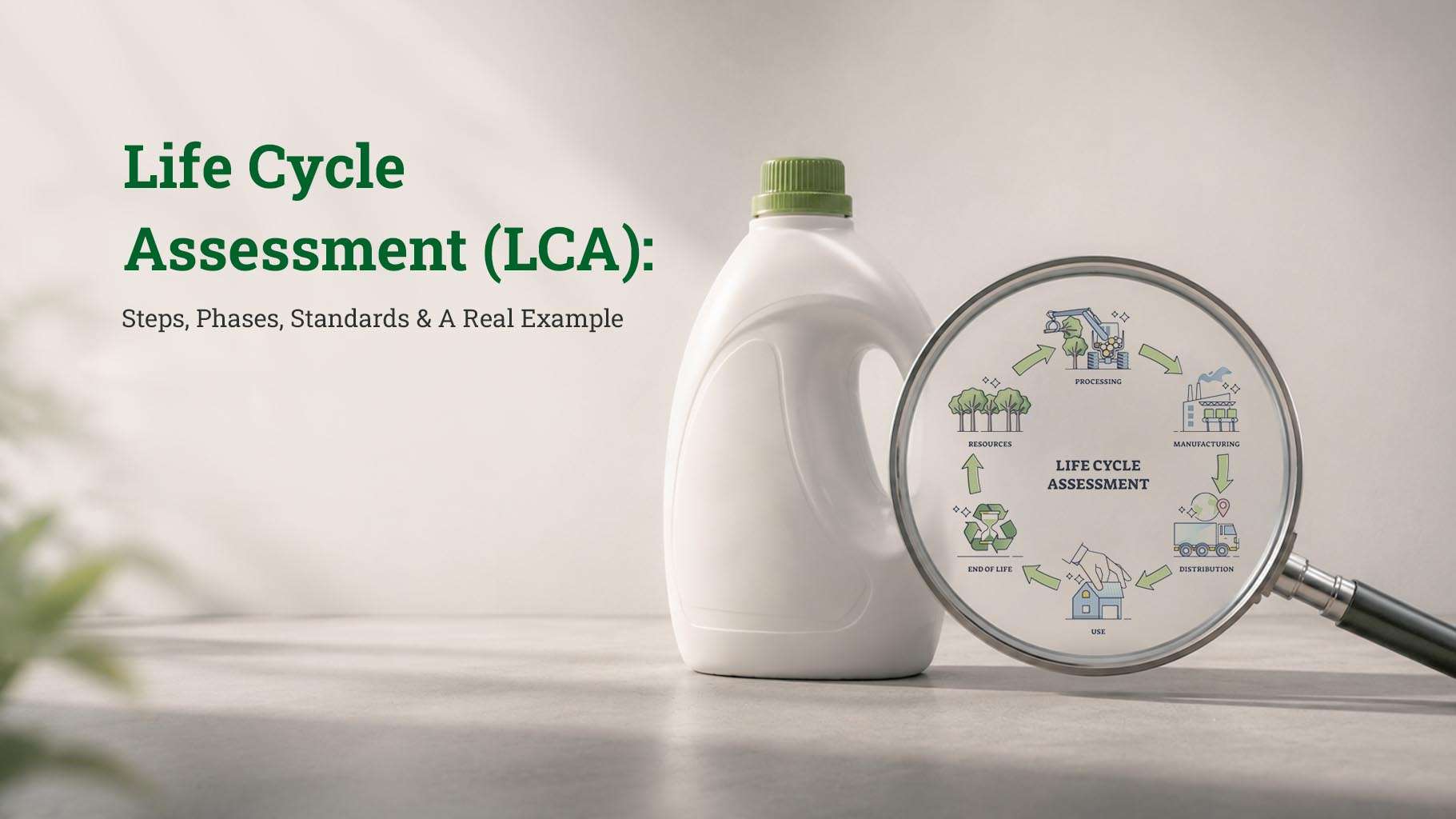
With carbon accounting and environmental accounting, it is important to know the environmental footprint of products in order to design them in a sustainable way. The “simple claims” and “unverified green labels” are no longer enough to demonstrate sustainability to organizations. Rather, stakeholders follow a scientific, data-based approach called a life cycle assessment to estimate the actual environmental impact of their products, from raw material consumption to end of life.
Life cycle assessment is an assessment of the overall environmental effects of a product during its life cycle. It traces energy consumption, GHG emissions, water consumption and waste generation through the whole supply chain, giving companies the visibility they need to identify carbon hotspots and optimize resource use. As more and more companies begin focusing on climate disclosures and the new Extended Producer Responsibility (EPR) regulations take effect, which will increasingly charge companies for linear business models, a precise life cycle assessment is becoming a central aspect of companies’ supply chain future-proofing. To avoid risks of operations, decrease carbon emissions and develop circular supply chains with a limited amount of resources, thoughtful companies break through unverified green claims and base sustainability plans upon solid information.
What Is a Life Cycle Assessment (LCA)?
Ask what is life cycle assessment, and it’s best understood as a science-based, standardized accounting framework that is used to measure the total environmental impact of a product, process or service. What is life cycle assessment, considers all life cycle stages of an item, from extracting raw materials from the ground, through manufacturing and distribution, consumer use, until it reaches the end-of-life processing stage. Now lets look at the stages of what is life cycle assessment is.
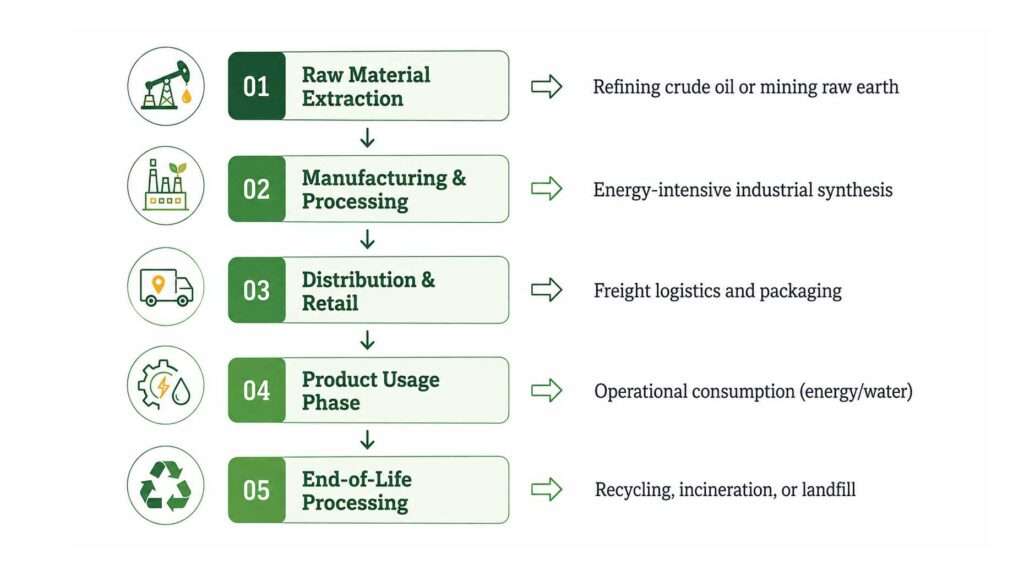
Implementing a life cycle assessment approach, manufacturers can prevent the “burden shifting” problem, which is solving one environmental problem at one time in the product lifecycle, and creating another at another time.
The 4 Phases (Steps) of a Life Cycle Assessment
Executing a standardized life cycle assessment requires following a structured four-stage framework. This systematic life cycle assessment methodology ensures that environmental claims are mathematically sound, repeatable, and globally comparable.
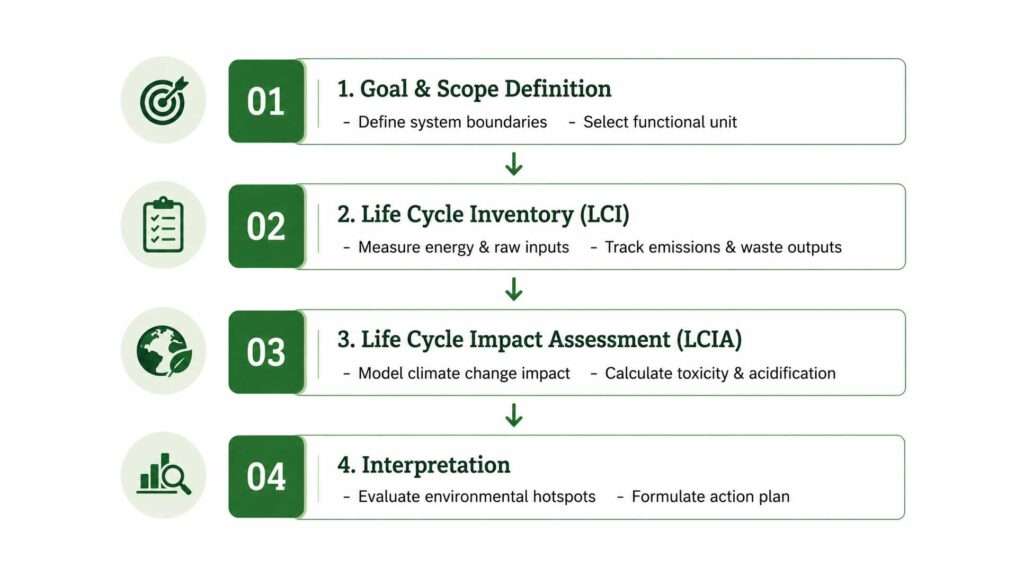
1. Goal & Scope Definition
The first stage of the life cycle assessment methodology is to clearly define the study’s purpose, audience and applications. In this case, the system boundary is defined (cradle-to-grave or cradle-to-gate) and a strict “functional unit” is set that presents a standardized base (e.g., 1,000 plastic bottles delivered) to enable fair comparisons between materials.
2. Life Cycle Inventory (LCI)
In the second phase of the life cycle assessment method, data collection takes place. An inventory of all physical inputs and outputs in the system boundaries is created by the analysts. Raw material, electricity, fuel and water are inputted and greenhouse gases, wastewater discharge, solid waste and chemical byproducts are outputted.
3. Life Cycle Impact Assessment (LCIA)
After the inventory data is gathered, the analysts turn the raw data into specific impacts on the environment. The LCI data is classified into separate LCIs according to verified impact models, including Global Warming Potential (CO2 equivalent), acidification, eutrophication, human toxicity and ozone layer depletion.
4. Interpretation
The last phase of the life cycle assessment methodology is the critical analysis of the inventory and impact results. Practitioners assess data quality, conduct sensitivity analyses, and pinpoint key environmental hotspots within the supply chain and provide data-driven product redesign or process optimization solutions.
LCA Methodology, Framework & Standards (ISO 14040 & 14044)
An environmental life cycle assessment (eLCA) should be conducted according to internationally accepted standards to avoid greenwashing and to be technically consistent across the globe. There are two fundamental life cycle assessment guidelines from the International Organization for Standardization (ISO):
- ISO 14040: Establishes the basic principles and qualitative structure of an environmental life cycle assessment, as well as the underlying rules.
- ISO 14044: Specifies the detailed quantitative criteria, technical guidelines, LCI data collection criteria and third-party review procedures required to validate an assessment.
By following these recognized life cycle assessment standards, an environmental life cycle assessment will provide credible data that are subject to regulatory review, carbon auditing and third-party audit.
Why Environmental Life Cycle Assessment Matters
A detailed environmental life cycle assessment is a strategic tool that goes beyond regulatory compliance. Having hard data to back up sustainability strategies ensures that the business is not exposed to environmental liabilities.
The key benefits the organisation gets from this are:
- Close the GHG carbon leakage “hidden hotspots”: Identify the specific emission sources in the manufacturing or logistics process where the highest GHG emissions occur.
- Simplification of Regulatory Compliance: Providing audited carbon footprint data for CPCB registration, Extended Producer Responsibility (EPR) reporting and carbon tax disclosures for international reporting.
- Defending Brand Equity: Delivering tangible information to support public sustainability assertions and help prevent allegations of greenwashing.
- Reducing Supply Chain Costs: Spotting areas of inefficiency in production that cost money – material and energy – and reduce the cost of operation.
Life Cycle Assessment Example: Virgin vs. Recycled Plastic
In this life cycle assessment example, we will compare the production of virgin plastic with recycled plastic.In this example, virgin plastic will be compared to recycled plastic.
Let’s examine the life cycle assessment example and see how it shows the obvious environmental benefits of circular materials over conventional petrochemical-based materials.
What about a comparative life cycle assessment of 1 ton virgin High-Density Polyethylene (vHDPE) and 1 ton Post-Consumer Recycled High-Density Polyethylene (pcr-HDPE)?
Assessment Parameter | Virgin HDPE (vHDPE) | Recycled HDPE (pcr-HDPE) |
Primary Feedstock | Extracted crude oil / natural gas liquids | Post-consumer plastic waste |
Energy Consumption | High (fossil extraction + refining) | Low (collection + mechanical hot-wash) |
Global Warming Potential | ∼1.9−2.5 kg CO2e / kg | ∼0.3−0.6 kg CO2e / kg |
Water Scarcity Impact | Significant (petrochemical refining) | Moderate (recycled wash-water loops) |
End-of-Life Trajectory | Adds new polymer mass to the biosphere | Diverts existing waste from landfills |
By using high-purity recycled polymers instead of virgin petrochemicals, this life cycle assessment example demonstrates that up to 80% less carbon is emitted, delivering a proven pathway to reduce Scope 3 supply chain emissions.
Product Life Cycle Assessment & the Circular Economy
Incorporating a product life cycle assessment into the early design stages of a product will help to shift the linear consumption pattern towards a real circular economy. Traditional linear models have a “cradle to grave” path, and circular engineering seeks to create a “cradle to cradle” cycle that recovers and re-engineers materials on an ongoing basis.
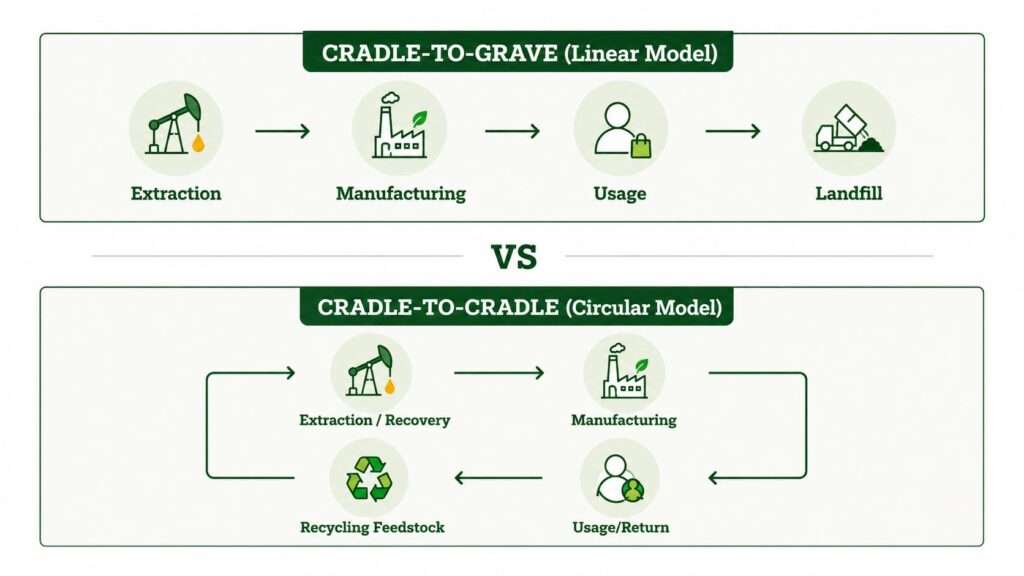
Using a product life cycle assessment process to evaluate raw materials helps packaging engineers design products for easy disassembly, eliminate toxic additives, and incorporate high percentages of post-consumer recycled content, keeping valuable polymers circulating through the economy indefinitely.
Life Cycle Assessment in Action: Banyan Nation’s Circular Plastic Model
Our industrial activities are built around quantitative sustainability principles at Banyan Nation. In the past, consumer brands around the world were not eager to use recycled plastics because of the lack of consistent quality and carbon reduction value.
We overcame this problem by combining a digitally traceable collection system with cutting-edge mechanical hot-washing and scientific decontamination. The proprietary manufacturing process transforms post-consumer polyolefins into the premium line of near virgin quality PCR HDPE and PP resins (Better Plastic™).
Third-party testing confirms that our high-purity PCR resins can contribute to reducing the carbon footprint of packaging by up to 80% over virgin petrochemical resins when used in our blow-molding and injection-molding production lines for FMCG and automotive brands. With consistent PCR granules and transparent, data-driven environmental indicators, Banyan Nation enables global enterprises to achieve their EPR goals, adhere to international principles and effortlessly move towards real material circularity.
FAQ's
What are the four phases of a life cycle assessment?
The four standardized life cycle assessment process defined by ISO 14040/14044 are: 1. Goal and Scope Definition, 2. Life Cycle Inventory (LCI), 3. Life Cycle Impact Assessment (LCIA), and 4. Interpretation.
What is the difference between an LCA and a carbon footprint?
A carbon footprint is a single-issue analysis that measures greenhouse gas emissions (CO2 equivalents). In contrast, a complete life cycle assessment framework is a broader evaluation that measures carbon emissions alongside multiple environmental impact categories, including water depletion, land use, ecotoxicity, acidification, and resource depletion.
Why is life cycle assessment important for businesses?
Life cycle assessment standard provides verified data required to identify supply chain carbon hotspots, optimize raw material efficiency, fulfill legal Extended Producer Responsibility (EPR) mandates, protect against greenwashing allegations, and lower Scope 3 greenhouse gas emissions.
What are the main limitations of an LCA?
Key limitations of life cycle assessment framework include high resource demands for comprehensive data collection, reliance on assumptions when primary supply chain data is unavailable, and variations in system boundaries across different studies that can complicate direct comparisons.
What is the difference between cradle-to-grave and cradle-to-cradle?
Cradle-to-grave tracks a product’s environmental footprint from initial raw material extraction down to its final disposal in a landfill or incinerator. Cradle-to-cradle evaluates a closed-loop system where end-of-life materials are recycled back into raw feedstock for new manufacturing, eliminating final waste.
Making recycled packaging the norm.
CITATIONS:
- International Organization for Standardization (ISO). ISO 14040:2006 & ISO 14044:2006 – Environmental Management: Life Cycle Assessment Principles, Requirements, and Guidelines.
- United Nations Environment Programme (UNEP). Global Guidance Principles for Life Cycle Assessment Databases and Circular Economy Metrics.
- Journal of Cleaner Production. Evaluating the Environmental Benefits of Mechanical vs. Petrochemical Polymer Chains through Standardized ISO LCA Methodologies.
 International E-Waste Day 2026: What It Means and How to Take Part
 What is Waste Disposal: Methods, Types, and Real-World Examples
 What Is Polyolefin? Types, Properties, Uses and Recyclability
 World Rivers Day 2026: Date, Theme, History and How to Take Part
 Zero Emissions Day 2026: What It Is, Why 21 September and How to Take Part