Plastic contamination, a term used in the environment science field and waste management, is the occurrence of substances other than plastics, chemicals, or other incompatible polymers in a given plastic waste stream. Plastic contamination is technically an insidious issue that involves the molecular and systemic level despite many individuals confusing it with the general littering. It occurs when food residues, adhesives, paper labels or even incompatible plastic resins (such as a PVC label on a PET container) find their way into the recycling feedstock, which effectively contaminates the batch. This is the main factor that causes millions of tons of materials that could have been recycled to be sent to the rejected processing plants and redirected to landfills annually.
The peculiarities of plastic contamination are also vital in terms of creating a genuinely circular economy since a contamination rate of 1 percent may severely affect the mechanical characteristics and safety of the resin that is produced after the recycling process. In the case of expensive uses, such as packaging of FMCG, purity is priority, and in this respect, plastic contamination is governed by sophisticated cleaning equipment and strict sorting procedures. The post-consumer waste potential can be tapped by tackling this challenge at the source through improved consumer habits, and at the industrial level through innovation. The dream of the close loop on plastic will not be achieved without a determined initiative to minimize plastic contamination because the quality of recycled plastic will never be uniform enough to substitute virgin plastics at the global level.
Introduction
One of the largest bottlenecks of contemporary sustainability activities is the global crisis of polluted plastic garbage. By contaminated plastic waste we do not mean dirty containers, we mean a failure systemic in the sense that it cannot manage material streams pure enough to reuse high-value materials.
The existence of contaminated plastic waste causes:
- Increased Processing Costs: More power and water will be required to scrub the materials.
- Downcycling: The bottles of high quality are converted into low quality park benches due to the fact that they are not pure enough to be packaged.
- Economic Losses: Recyclers are lost in connection to recycling products that do not comply with the industrial level.
What is Plastic Contamination?
Then, what is plastic contamination? Contaminated plastic waste is the introduction of non-targeted materials into a recycling batch. This may be organic (food/liquid), inorganic (dirt/metal), and biological. The issue of plastic pollution in water has become a significant topic in the recent years as microplastics and chemical additives percolate our ecosystems.
On examining the meaning of plastic contamination, we see that it is categorized into three broad groups:
- Physical: plastic mixed with dirt and stones and scraps of metals.
- Chemical: Removing any residual oils, detergents or dyes which change the chemistry of the polymer.
- Biological: Biological waste or fungi that develop on the poor storage of plastic contamination in the water.
Knowledge of plastic contamination in water and soil is crucial since such pollutants finally find their way into the human food chain by a process referred to as bioaccumulation.
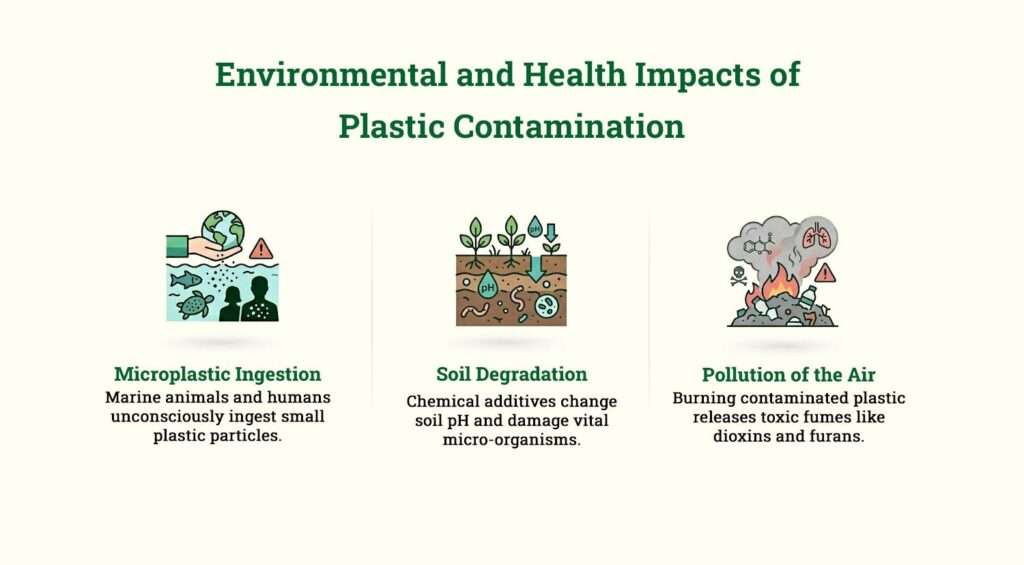
Environmental and Health Impacts of Plastic Contamination
The stakes are high in the case of the contamination of plastic. In case of contamination of plastic water bottles, it does not only influence the ability of the bottle to be recycled; it is dangerous to human health due to the leaching of endocrine-disrupting substances such as Phthalates or BPA. Effects of plastic contamination in water and overall waste encompass:
- Microplastic Ingestion: Marines and people take small particles of polluted sources of plastic water bottles through plastic contamination in water without realizing it.
- Soil Degradation: Chemical additives as a result of plastic contamination may cause a change in soil pH and damage vital micro organisms.
- Pollution of the Air: In case contamination plastic is burnt, it leads to the release of toxic fumes such as dioxins and furans into the air.
Challenges in Recycling Contaminated Plastic Waste
Plastic water bottle contamination is an uphill task to recyclers. Contamination plastic in a stage of waste might destroy valuable equipment and ruin whole production lines. The main problems in relation to plastic water bottle contamination are:
- Label and Adhesive Removal: The regular glues are commonly hard to clean up in a simple wash.
- Multi-Material Design: It is a type of product that combines plastic and foil or paper and establishes a permanent contamination of plastic and cannot be easily remedied through mechanical recycling.
- Incompatible Resins: Even one PVC cap in a ton of PET can have the whole batch of the resin turn yellow or brittle when melting.
- Smell and Odor: The recycled resin cannot be used to manufacture personal care products due to the persistence of a smell that is often present in food based plastic bottle contamination.
Solutions to Reduce Plastic Contamination
A combination of improved design, consumer behavior, and industrial technology would decrease the contamination of plastic. In response to the question of what plastic bottle contamination is, it will be necessary to consider how it can be prevented at the outset.
Key strategies include:
- Source Segregation: The practice of households washing and drying their recyclables should be encouraged.
- Mono-material Design: Brands that shift to use single-polymer packaging in order to prevent plastic contamination on the inside.
- Chemical Recycling: Recycling by heating or to a chemical to de-polymerize the polymers into their constituent monomers, which are resistant to certain forms of physical contamination.
- Standardized Labelling: It involves application of wash-off labels which can readily be removed in the recycling process.
How Banyan Nation is Tackling Plastic Contamination in India
Banyan Nation has been the first to offer the world-class solution to the issue of contamination plastic in the Indian setting. Understanding that a large proportion of waste is usually very mixed in India we have invented a proprietary cleaning technology that is very high-efficiency which wipes 98 percent of pollutants such as lingering odors and inks that are not easy to remove.
Transforming the polluted plastic waste into Better Plastic, our trademark, we offer to the brands a safe, uniform, and brand-ready resin. We do this through a digital chain of custody of material, whereby the waste picker to the end pellet is traced, so that the pollution of plastic is controlled at each and every point of contact.
Conclusion
The determinant of the sustainable future is whether to combat plastic contamination or not. At the personal level of washing a yogurt container to the industrial one of the high-tech washing lines in the Banyan Nation, a step will matter. Although the problem of contaminated plastic waste poses a huge barrier, it is not impossible to overcome it. Knowing what plastic contamination is and investing in technology to manage it, we will be able to turn our waste into a high-value resource instead of an environmental burden. The aim is easy to understand: the world in which plastic is not dirty, and all bottles get the second, third, and fourth lives.
FAQ's
What is the difference between plastic pollution and plastic contamination?
Plastic pollution can be defined as the literal presence of plastic garbage in the environment (such as a bottle on a beach). Plastic contamination is seen to mean the impurities that are contained in the plastic material (such as food remains or mixed resins) that makes it not be recyclable effectively.
How does contamination affect plastic recycling efficiency?
Pollution leads to the waste of resources in terms of water and energy spent to clean up. When the pollution of plastic is excessive, the substance becomes either too weak to be used in the process or too ugly to be recycled, compelling recyclers to downcycle or dispose it to a landfill facility.
What types of contamination are commonly found in plastic waste?
The most prevalent ones are organic food waste, paper labels, metal foils, adhesives, and incompatible plastic types (such as PVC that is mixed with PET).
Can plastic contamination be removed completely during recycling?
Normal recycling usually produces residual contamination. Nevertheless the high end packaging can be achieved by using highly developed technologies such as the proprietary cleaning technology at Banyan Nation which has the potential of eliminating up to 98 percent of the impurities.
Making recycled packaging the norm.
CITATIONS:
- National Environmental Engineering Research Institute (NEERI). (2025). Study on Plastic Contaminants in Indian Urban Waste.
- Banyan Nation. (2026). Removing the Invisible: Our Patented Cleaning Process for PCR.
- The Journal of Hazardous Materials. (2024). Leaching of Chemicals from Contaminated Plastic Water Bottles.
- World Wildlife Fund (WWF). (2025). The Impact of Plastic Contamination on Marine Ecosystems.
 World Rivers Day 2026: Date, Theme, History and How to Take Part
 Zero Emissions Day 2026: What It Is, Why 21 September and How to Take Part
 World Cleanup Day 2026: Date, Theme and How You Can Take Part
 What is Polypropylene Plastic?
 What Is a Carbon Footprint? Meaning, Calculation & How to Reduce It