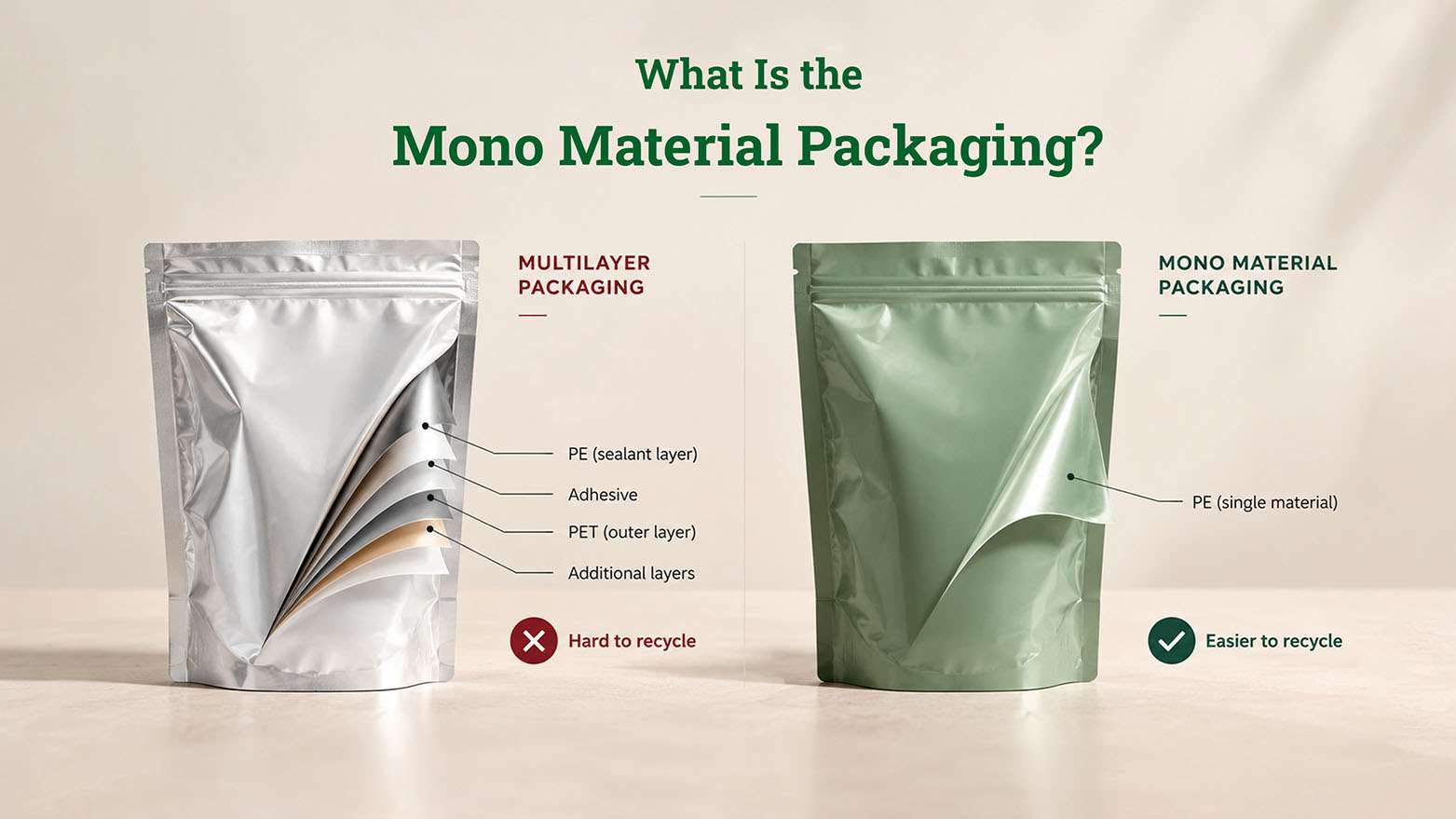
Mono-material packaging is packaging which is largely made up of a single and compatible material type such as polyethylene (PE) or polypropylene (PP). It can be used as bottles, containers, pouches and flexible films meaning it can be easily sorted and recycled.
Unlike complex multi-layer laminations, mono-material packaging is designed to make it easy to recycle. However, not all packaging made from a single material family can be recycled. The inks, adhesives, labelling, barrier coatings and how it is collected will affect how it can be recycled.
This is important as the packaging needs to protect the product effectively whilst also allowing it to be recovered.
Why Traditional Multi-Layer Packaging Cannot Be Easily Recycled
Flexible packaging is often designed with multiple layers to protect the products from moisture, oxygen, light and other external forces. Traditional laminations use multiple materials to give the required properties.
A flexible laminate could have a PET or BOPP layer for printing and structural properties, an aluminium foil layer for an oxygen barrier and PE layer for heat sealing. Adhesives are then used to stick everything together.
Once the packaging has been used the materials are stuck together and cannot usually be separated easily using traditional mechanical recycling methods. Mixed material laminations can be hard to identify, sort and produce a uniform recycled material.
This means many of these packages have limited options for material to material recycling.
Mono-material packaging can be used to ensure the necessary functions are retained but designed with a compatible material family.
Mono Material Packaging Meaning and Definition
The meaning of mono material packaging is not just using a single type of plastic as the main component of the package. The layers, closures, labelling, inks and other components need to be considered to ensure compatibility with a recycling stream.
A traditional pouch might have a printed PET or BOPP layer, aluminium foil barrier and PE sealing layer. Whereas a mono-PE package could have an oriented PE layer for printability and rigidity and a compatible PE sealing layer.
This allows the essential functions to be retained but makes it easier to identify, sort and recycle.
The main thing to remember is designing for the next life of your material.
Mono Material vs. Multilayer Packaging: What’s the Difference?
Feature | Mono-material packaging | Traditional multilayer packaging |
Material structure | Primarily one compatible polymer family | May combine different polymers, aluminium foil and adhesives |
Sorting | Can be easier to identify when designed for the relevant sorting system | Complex structures can be harder to identify and separate |
Mechanical recycling | Can be compatible with an established polymer recycling stream | Material separation is often difficult or uneconomical |
Barrier performance | Requires suitable material design and, where necessary, compatible barrier technologies | Often achieved through combinations of specialised layers |
Circularity potential | Can support material recovery and reuse in new products | Depends on whether a practical collection and recycling route exists |
The main difference lies in material compatibility and the ability to recover the packaging after use.Mono-material packaging is not automatically recyclable, and multilayer packaging is not uniformly unrecyclable in every system. The outcome depends on the pack’s composition, its design and the infrastructure available to process it.
Common Types of Mono Material Packaging
- Mono-PE Packaging
Polyethylene is a versatile material that provides good flexibility, water resistance and heat sealability.
Mono-PE packaging is formed by combining compatible PE films to create a pouch or refillable pack. Orientated PE films can be used to provide rigidity and printable surfaces. PE layers can be used to form good seals.
Used in: Detergent refill pouches, liquid hand wash refillable packs and some dry product packaging.
- Mono-PP Packaging
Polypropylene provides a clear, rigid material that is heat resistant. It can therefore be used in rigid and flexible packaging.
Mono-PP packaging can be formed using rigid or flexible compatible materials. Biaxially-oriented Polypropylene (BOPP) films are also commonly used within packaging. It is important to ensure that all elements of the packaging including sealing, labelling and other features are compatible with your recycling process.
Used in: Some rigid food packaging, tubs and flexible snack packaging designed for PP recycling.
Mono-material designs beyond the main pack
Packaging can only be recycled according to how it is designed. Labelling, closures, adhesives, coatings and printing can all impact upon the quality of the recovered material.
With plastic packaging it’s important to use as few incompatible elements as possible to ensure everything works well with your recycling process. Paper-based packaging will have a different recycling process to consider.
Benefits of Mono Material Packaging for Recyclability
1. Easy to sort
Packages can be designed with compatible polymer families and clear identification to make sure it goes in the right stream.This can help cut down on complexity when sorting.
2. Better quality recycled material
Incompatible polymers, leftover materials, inks and other materials can cause issues with the properties of the recycled plastic. Compatible mono material packaging can help to reduce issues with incompatibility and create more uniform recycled resins.
Quality will depend on how it has been collected, sorted, washed, decontaminated and processed.
3. Create a circular material
Mono material packaging can be valuable if it can be recycled and the material can be used again.
For example, mono material secondary packaging can be collected, sorted and recycled back into material to create the same packaging. This creates a more circular material as it can go back into the same application.
However, a multi-layer laminate for laundry products made from incompatible materials may not be able to go back into the same packaging. Even if it is collected, the layers may be bonded together so will not be able to be recycled back into the same packaging via standard mechanical recycling. Depending on the recycling process available it may be put into a different application or disposed of.
The first step in creating a circular material is collecting the material. Ensuring it can be recovered so it can be used again will help to create a circular process.
4. Can help achieve packaging and EPR goals
By designing your packaging to be recyclable you can help your brand reach their circular packaging goals and any relevant EPR requirements.
However, just having mono material packaging will not guarantee you meet your EPR requirements. You should consider what your requirements are, what category your packaging falls into, what recycled content requirements you have and what recycling processes are available.
Why Packaging Design Must Work for Waste Pickers and Aggregators
There are often waste pickers, scrap merchants and aggregators in many markets that collect, identify, sort and consolidate recyclable materials.
Packaging design can play an important role in ensuring materials can be identified as valuable recyclables.
To assist with this, the Consumer Goods Forum has produced guidelines around packaging design. This includes guidance around material selection, limited printing, component compatibility and clear recycling messaging. It also notes the importance of considering how materials will be sorted manually and the needs of people working within the informal waste sector.
Flexible packaging can take advantage of this opportunity by designing mono-structures, limiting unnecessary printing and including clear and easily identifiable material identification to help identify mono structures.
Whilst a simple and consistent visual could make it easier for waste pickers and aggregators to identify what material they have, this should be developed with recyclers, waste workers and key stakeholders in the industry to ensure it is appropriate for their local sorting processes and labelling requirements.
Improved packaging design can help with identification for collectors, efficient segregation by aggregators and consistent feedstock for recyclers.
Can Better Identification Improve Flexible Packaging Recycling?
Material design is important however accurate identification and sorting can also play an important role, particularly around flexible packaging.
Digital watermarking is a new method available where codes can be added to packaging artwork. Sorting systems can then identify what information has been included to help sort materials. Depending on the information included, this can help identify attributes of the material, for example what material it is and if it has previously been used for food.
Mondelēz International, PepsiCo and pladis carried out a trial across Belgium in 2026 looking at how digital watermarking could improve identification and sorting of flexible food packaging. This will provide real world data around identification and potential recycling routes.
This demonstrates how artwork and printing can be used to identify materials.
Digital watermarking is a new technology, so it is dependent on having sorting equipment that is compatible, collection systems, appropriate recycling and quality requirements.
Visual identification and practical design is still a key consideration for markets that have high manual collection and sorting processes such as India. Whilst technology can help, the system must be effective for those involved.
Mono Material Packaging and the Future of Circular Packaging
More and more innovation is occurring around packaging to ensure the material science, manufacturing and end of life recovery are brought together.
Recent partnerships within the industry show how important it is to work across the value chain. Amcor and Dow announced a partnership in September 2026 to help brands understand and scale low carbon packaging solutions. Using packaging knowledge, material science, carbon footprint information we can provide insight into what options are technically and commercially viable.
Overall there isn’t going to be one decision you can make to make your packaging circular. You need to consider the materials available to provide protection, manufacture, recovery, sorting, recycling and commercial viability.
As a brand you should ask yourself:
- Can the pack provide the required barrier/seal properties?
- Are the layers, labelling, inks and adhesives compatible with your desired recycling stream?
- Can waste pickers, aggregators and sorting centres recognise and sort your packaging?
- Is there a collection and recycling route?
- Is there an application for the material?
By doing this you can ensure your packaging will be designed for recovery rather than just theory.
How Banyan Nation Help with Recyclable Mono Material Packaging
Whilst having a recyclable package is important, it is also important to have a reliable circular material. This requires a good collection, sorting, processing and end market.
Banyan Nation help to create circular plastics by converting post consumer plastic waste into recycled polymer resins. They use their unique washing, sorting and compounding technology to produce recycled PE and PP resins.
They help to create a reliable recycled material source so you can create an ecosystem to use recycled polymers.
Working with packaging manufacturers and brands you can ensure your packaging will be designed to work with material recovery. This could include using compatible structures, improved recognition and working with the recycling value chain. You could also look to use recycled resins in your application.
FAQ's
Is mono-material packaging recyclable?
Mono-material packaging can be easier to recycle when its components are compatible with an established collection, sorting and recycling system. Actual recyclability depends on the complete package design, material composition and local infrastructure.
What are examples of mono-material packaging?
Examples include compatible PE refill pouches, PP containers and flexible films designed around a single polymer family. Labels, closures, inks, adhesives and barrier coatings must also be assessed for compatibility.
Is mono-material packaging always better than multilayer packaging?
Not automatically. Packaging must provide adequate product protection and shelf life while also enabling recovery. Mono-material designs can improve recycling compatibility, but their performance, barrier properties and end-of-life pathway must be evaluated for the specific application.
Can mono-material packaging provide adequate barrier performance?
Potentially, yes. Polymer orientation and selected coatings or barrier technologies can improve performance. However, the appropriate solution depends on the product, required shelf life, processing conditions and compatibility with the intended recycling stream.
Why is multilayer packaging difficult to recycle?
Many multilayer packs bond different polymers, aluminium foil and adhesives into a single structure. Conventional mechanical recycling generally cannot separate these materials economically, making it difficult to recover a consistent polymer stream.
How can packaging design help waste pickers?
Packaging that uses compatible materials, avoids unnecessary printing and provides clear, easy-to-recognise material identification can make it easier for waste pickers and aggregators to identify and segregate recyclable items. The design should reflect local collection practices and be developed with the people who handle the material.
Does mono-material packaging guarantee EPR compliance?
No. Mono-material design may support recyclability objectives, but EPR compliance depends on the applicable rules, packaging category, required documentation and relevant recovery or recycled-content obligations.
Making recycled packaging the norm.
CITATIONS:
- Packaging Europe, How packaging design helps waste pickers in low- and middle-income countries.
- Amcor, Amcor and Dow launch strategic collaboration to accelerate adoption of low-carbon packaging solutions.
- FoodBev Media, Mondelēz, PepsiCo and pladis join digital watermarking trial for flexible food packaging.
- The Consumer Goods Forum, Golden Design Rules.
 What Is Mono Material Packaging? Benefits for Recyclability
 What Is a Recycle Bin? Meaning, Colours & Types
 What Is the Waste Disposal Hierarchy? 5 Steps Explained
 What Is ABS Plastic? Properties, Uses & Recycling
 International E-Waste Day 2026: What It Means and How to Take Part