In this fast-paced society, characterized by rapid urbanisation and unprecedented industrial consumption, the adoption of sustainable waste management has become not an option but a necessity for the ecology. Sustainable waste management is a general term that encompasses the planning, collection, processing and end-of-pipe waste treatment of waste materials that are strategically implemented and have the least possible impact on the environment, that can be kept in finite natural resource stocks, and that have the highest possible economic value for the future. This forward-looking concept has a different perspective on waste as a resource for secondary raw materials, instead of a dirty burden to be deposited in the landfill. The mechanical and chemical recycling process is the driving force of the whole paradigm shift and is at the very heart of systemic source recovery. Recycling disrupts the destructive linear economy of ‘extract-manufacture-dispose’ directly by transforming waste materials into high quality industrial feedstock. As carbon accounting laws and Extended Producer Responsibility (EPR) requirements come under pressure throughout the world, the optimization of sustainable waste management workflows is key for businesses to de-risk their material supply chains in 2026. It needs an integrated view of the design, production and reverse logistics of products. Modern companies can systematically reduce their carbon footprint, safeguard endangered planetary biodiversity and create a very resilient industrial system, if they focus on circular material recovery cycles rather than the traditional extraction process.
Introduction
Global climate goals involve a fundamental coupling of strategies for industrial sustainability and waste management in order to be achieved in the long-term. The encounter between sustainability and waste management is only possible to understand when waste is no longer something to be hidden, but is no longer an issue if there is no waste at all: conscious, closed-loop processing systems.
Sustainability and waste management programs can be successfully integrated to enable industries to:
- Reduce Legal Risks: Complying with strict national environmental requirements and avoiding high penalties for non-compliance.
- Maximize Resource Efficiency: Replace carbon-intensive and volatile virgin resources with reliable, circular recycled feedstock.
- Raised Brand Equity: Meeting the consumers’ increasing demand for Authenticity and radical transparency of eco-certified products.
What is Sustainable Waste Management?
For waste management to fully realize its role in sustainability, we need to break out of the rut of the traditional waste disposal model and adopt a holistic perspective on resource conservation. In waste management for sustainable development, every single item brought into the municipal or industrial stream must have a clear “next life” and highly structured.
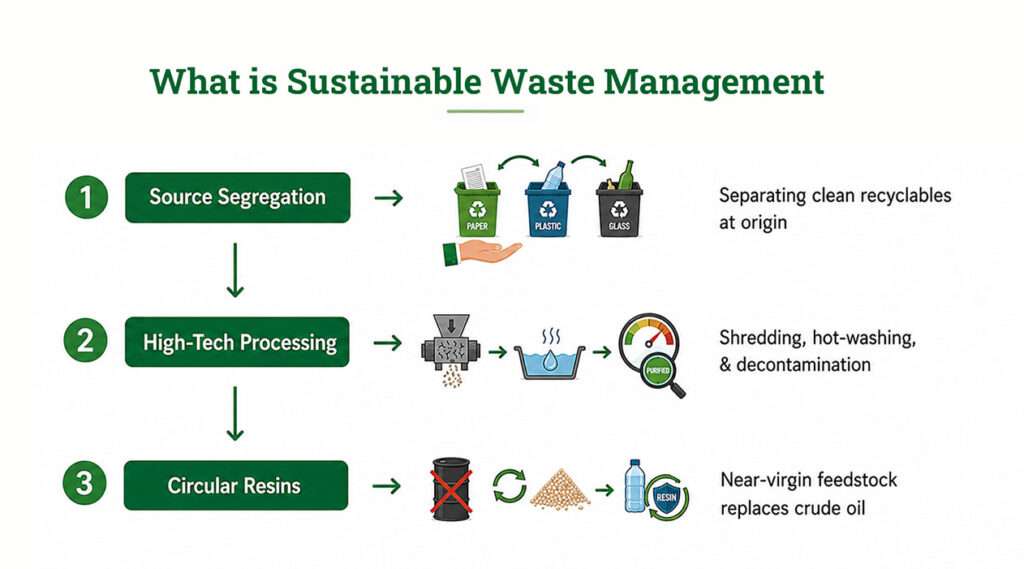
Waste management for sustainable development framework has a strong dependence on the waste hierarchy which is recognized in the world. This model applies the lowest priority to waste disposal, with the highest priority given to waste prevention and reduction, which is followed by high purity recycling and energy recovery; and the lowest priority to regular land disposal.
Why Recycling is Important for Waste Management and Sustainable Development
Waste management for sustainability is one of the first building blocks in the realization of the United Nations Sustainable Development Goals (SDGs). Integrating the concepts of waste management and sustainable development into local city planning ensures that city development does not lead to irreversible environmental degradation.
Recycling is the key pillar of waste management for sustainability, contributing by:
- Conserving Natural Ecosystems: Do not have to clear forests immediately for the purpose of mining or taking crude oil from forests for basic polymer production.
- Up to 80% less energy is used to process post-consumer waste as compared to virgin materials from the start.
- Creating Green Employment Opportunities: Development of organized and formalized labor market around collection, sorting and high-tech material processing with inclusivity.
In this linkage of waste management and sustainable development, waste has become an effective driver of green macro-economic development.
Sustainable Waste Management Practices That Support Recycling
Municipalities and corporations need to adopt certain standardized sustainable waste management practices to develop a consistent and reliable premium recycled material supply. These sustainable waste management practices are environmentally friendly and aim to prevent economically lost items from being contaminated by waste.
Key practices for circular material loops are:
- Source Segregation Mandates: Enforcement of Wet Organic Waste Separation and Dry Recyclables and Hazardous Waste Separation at Source.
- Localized “decentralized” Material Recovery Facilities (MRFs): Development of local sorting centres to reduce transport emissions and improve the management of material consolidation.
- Digital Traceability Systems: Using computer-based tracking systems to record the path that waste takes from the first collector to the last industrial processor.
Sustainable Plastic Waste Management and Recycling
Sustainable plastic waste management is a key component in combating pollution worldwide. The problem with disposing of plastic waste is that it does not degrade naturally for centuries, so that traditional plastic disposal systems are clearly not working. Sustainable plastic waste management is the major challenge of the industrial world today.
In this sector, advanced mechanical decontamination must be a focus for achieving true circularity. Loop-to-loop recovery, as opposed to the lower value downcycling, means that a plastic package discarded by a customer can be safely recovered and re-engineered into the same package format for as long as it is in use.
Sustainable Waste Management Examples Across Industries
Looking at a case study of sustainable waste management examples can give you an idea of how these principles of the circular economy are put into practice in different markets. In recent years, different industries have applied specific examples of sustainable waste management in order to reach the “absolute zero” waste-to-landfill condition.
Industrial implementations include:
- The Fast-Moving Consumer Goods (FMCG) Sector: Creation of personal care bottles using 100% Post-Consumer Recycled (PCR) plastics – not virgin petrochemicals.
- The Construction and Demolition Industry: Smashing concrete waste and brick chunks into new eco-certified buildings’ structural aggregates.
- The Fashion and Textile Industry: Recycling of post-industrial fabric waste and converting them into high quality circular yarns for sale.
Benefits of Sustainable Waste Management Through Recycling
There are significant, compound benefits of sustainable waste management in regional ecosystems, but also for businesses’ bottom lines as well, when it comes to implementing scalable sustainable waste management solutions. These eco-friendly waste management strategies showcase that sustainable practices can be economically advantageous in the industrial sector.
Some of the main advantages of sustainable waste management are:
- Landfill Divergence: Avoiding millions of tons of non-biodegradable waste that takes the space of valuable land and leach toxic chemicals.
- Supply Chain Security: Supporting manufacturers to have a reliable and climate-resilient supply chain for raw materials that is sheltered from geopolitical risks in the international market.
- Energy Conservation: Reduction of the national grid’s demands with the use of pre-processed scrap materials instead of the use of energy-intensive raw extraction.
In implementing these sustainable solutions for waste management, modern brands can turn waste obligations into sustainable resource assets that can benefit their businesses for years to come.
How Banyan Nation Supports Sustainable Waste Management Through Recycling
Banyan Nation is at the very cutting edge of sustainable solutions for waste management in the Indian industrial sector. As a group we saw early on that the main reason why global brands were reluctant to roll out recycled plastics was because there was a systemic lack of the purity and consistency of the material. We use proprietary hot-wash processes and cutting-edge scientific decontamination methods to repurpose post-consumer plastic waste into a range of near-virgin quality PCR resins, known as Better Plastic™.
Our data-driven supply chain ensures absolute traceability and allows the major brands to comply with their strict CPCB guidelines, thus earning valid EPR credits and confidently moving their product lines into true environmental sustainability.
Conclusion
For an industrial society with a finite planet, the only sensible strategy is to implement a sustainable waste management system. We can systematically design waste out of our economic systems using the power of advanced recycling and by doing disciplined segregation. Adopting these circular approaches will help our industries safeguard the environment, strengthen our resource supply chains, and create a future that is sustainable, with everything that is created and used having a clear purpose.
FAQ's
What are the environmental benefits of sustainable waste management?
The primary environmental benefits include a massive reduction in greenhouse gas emissions, the preservation of natural habitats by stopping resource extraction, and the complete prevention of toxic chemical leaching into local soil and groundwater systems.
How does sustainable waste management support the circular economy?
It supports the circular economy by ensuring that materials are never discarded as useless trash at the end of their lifecycle. Instead, it systematically captures, purifies, and re-routes waste back into the production loop as high-value raw inputs.
How does sustainable waste management help reduce landfill waste?
It directly cuts down landfill volume by implementing source segregation, composting organic matter, and utilizing high-purity recycling systems to divert non-biodegradable materials away from dumpsites and back into factory production lines.
How does waste segregation support sustainable waste management?
Waste segregation is the vital first step that prevents cross-contamination. Separating dry recyclables from wet food waste ensures that materials like plastics, paper, and glass remain clean, dry, and highly viable for industrial recycling processes.
Making recycled packaging the norm.
CITATIONS:
- United Nations Environment Programme (UNEP). Global Waste Management Outlook and Sustainable Development Goals.
- Ministry of Environment, Forest and Climate Change. (2026). National Framework for Solid and Plastic Waste Circularity.
- World Resources Institute (WRI). The Economic and Climatic Advantages of Zero-Waste Industrial Infrastructure.
 World Rivers Day 2026: Date, Theme, History and How to Take Part
 Zero Emissions Day 2026: What It Is, Why 21 September and How to Take Part
 World Cleanup Day 2026: Date, Theme and How You Can Take Part
 What is Polypropylene Plastic?
 What Is a Carbon Footprint? Meaning, Calculation & How to Reduce It