Plastic flakes are the stage in the complex journey of plastic waste management in which waste is converted into a valuable industrial product. Plastic flakes are a refined intermediate product in the process of sorting and cleaning post-consumer plastic (such as bottles, containers and packaging) and then mechanically shredded. These small, uniform plastic pieces become the raw material needed for the next phase of the circular economy, and they help to connect “dirty” waste with “clean” manufacturing. Plastic flakes are formed by mechanical crushing and come with a high amount of polymer integrity, which is ideal to start high-quality upcycling. The presence of high purity plastic flakes is important in a country as diverse as India, where the waste stream is often very heterogenous. The flakes provide manufacturers more than just shredded plastic—they represent the tangible result of a brand’s dedication to sustainability. The plastic flake market has emerged as a vital component of the global supply chain, offering a sustainable and cost-effective solution to virgin petrochemicals, especially as demand for recycled content rapidly increases in 2026. When these plastic flakes are optimised for size, cleanliness and thickness, recyclers can ensure the end product of the pellets are able to meet the rigorous performance and safety requirements demanded by today’s packaging for FMCG and industrial applications.
Introduction
Recycled plastic flakes need to be of a high quality to make the transition from linear to circular economy possible. If the high purity recycled plastic flakes were not available, it would be virtually impossible to produce durable and safe recycled products, since the contaminants would adversely affect the mechanical properties of the plastic.
Excellent quality recycled plastic flakes are available for:
- Improved Processing: 100% washable and decontamination.
- Space-saving: Takes up much less room than large plastic containers.
Resource Optimization: Ready to melt feedstock for a variety of industrial extruders.
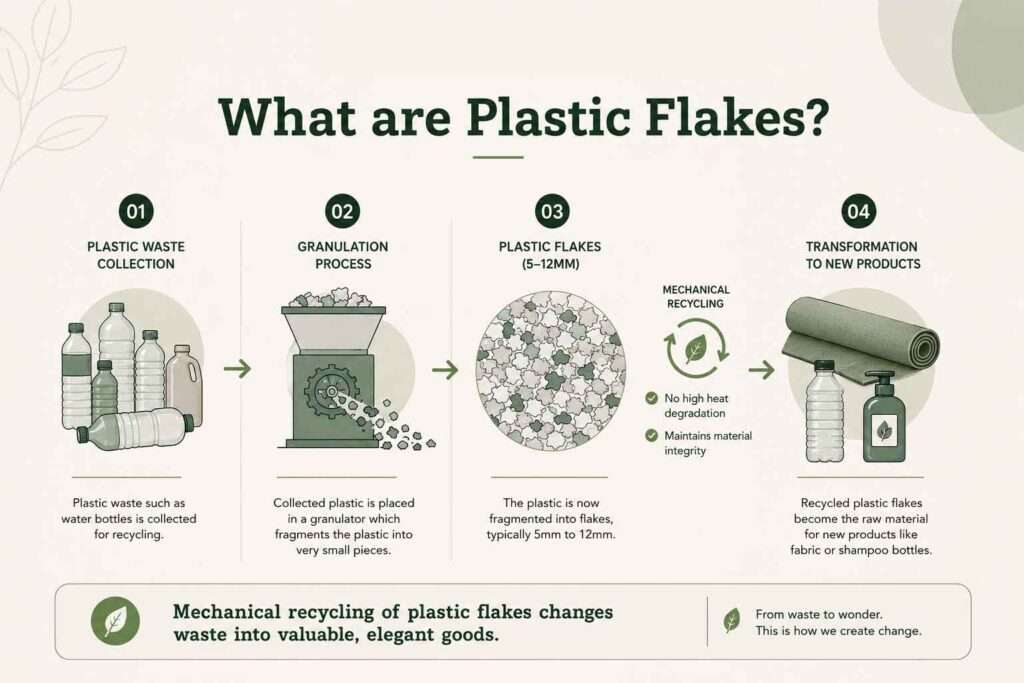
What are Plastic Flakes?
In case you’re unsure, plastic flakes are the “shredded” equivalent of plastic waste. Once collected, plastic is placed in a granulator which will fragment the plastic into very small pieces, typically 5mm to 12mm.
Now, what is recycled plastic flakes? Recycled plastic flakes is the term used for the end-of-life result of mechanical recycling, a process which does not involve the high heat degradation used in chemical recycling. It is important to understand what are plastic flakes to understand how we change from a thrown away water bottle to an elegant fabric or a new shampoo bottle.
Types of Plastic Flakes
Not every shredding produces the same shredding material; it refers to the types of plastic flakes based on resin type. It’s important for manufacturers to be aware of these types of flakes in order to make sure they’re compatible with their molding machines.
The most prevalent types of plastic flakes are:
- PET Flakes: The flakes are produced from beverage bottles, and generally utilized for making polyester fiber or edible/packaging materials.
- HDPE Flakes: Milk jugs and detergent bottles made, suitable for pipes and household containers.
- PP Flakes: Made from bottle caps and food trays, has a high heat-resistant performance.
- LDPE Flakes: Mostly from flexible films and bags, for making agricultural liners.
Importance of Plastic Flakes in Recycling
The importance of plastic flakes in recycling primarily is that they enable deep cleaning. The surface area is increased due to the shredded nature of the material which enables a washing system to remove 99% of labels, glues and organic residues.
The importance of plastic flakes in recycling is mainly due to:
- Scrubbing off Contamination: Flakes are easier to “scrub” than bottles.
- Advanced optical sorters: Used to ensure colour uniformity in batches for colour sorting.
- Homogenization: Flakes of various origins are mixed together creating a more uniform “melt” for the final resin. It is the significance of plastic flakes in recycling that makes the difference between a “premium” and a “low-grade” recycled product.
Plastic Flakes Uses: Key Applications & Industries
Plastic flakes uses are varied, as is the versatility of the material. Today, these flakes are used in a variety of sectors such as fashion, heavy construction, to name but a few, to build modern sustainable products.
Examples of plastic flakes uses are:
- Textiles: PET flakes are used to spin polyester yarns for use in clothing and carpets.
- Packaging: Thermoforming flakes into new trays, clamshells, non-food containers.
- Materials: The materials for drainage pipes and geo-grids are HDPE and PP flakes.
- Automotive: Using recycled flakes for non-visible applications in vehicles such as splash guards and wheel liners.
Industrial knowledge of these plastic flakes’ uses makes recycled material a high performance alternative to conventional resins.
Benefits of Recycled Plastic Flakes vs Virgin Plastic
When comparing plastic flakes vs virgin plastic, the environmental data is clear. While virgin plastic is derived from crude oil, recycled plastic flakes utilize existing waste, drastically reducing the carbon footprint of production.
| Feature | Plastic Flakes (Recycled) | Virgin Plastic |
|---|---|---|
| Source | Post-consumer waste | Petroleum/Crude oil |
| Energy Consumption | Up to 80% lower | High |
| Carbon Emissions | Significantly reduced | High |
| Water Usage | Closed-loop washing | High industrial use |
The plastic flakes vs virgin plastic debate is increasingly leaning toward flakes as technology improves the purity and consistency of the recycled material.
How Banyan Nation’s Recycling Process Produces Premium-Quality Plastic Flakes
We know that the quality of the flake makes the quality of the final pellet at Banyan Nation. Our process is designed to create high quality recycled plastic flakes that are “near virgin”. All flakes are hot washed/friction cleaned to guarantee that no adhesives and odours are attached. Plastic flakes’ technical value in recycling is the focus and we ensure our partners the recycling of a material that fits within their current production lines, so the transition to circularity is both profitable and sustainable.
Conclusion
Plastic flakes are the silent workers of the circular economy, whether they are used to make fleece jackets or form new plastic bottles. Knowing the details of recycled plastic flakes and the different plastic flakes can help businesses make the best choice when it comes to material sourcing. As we aim for a waste-free 2026, plastic flakes will become increasingly significant to recycling. The high quality flakes today will lead to a cleaner, more resilient planet tomorrow.
FAQ's
How are plastic flakes different from plastic pellets?
Flakes are the raw, shredded pieces of waste that have been cleaned but not yet melted. Pellets (or granules) are the final product created by melting the flakes and extruding them into uniform shapes for easier manufacturing.
Can all types of plastic be turned into flakes?
How is the quality of recycled plastic flakes measured?
Quality is measured by “purity levels” (lack of contaminants like paper or glue), moisture content, and “bulk density,” which affects how they melt in the extruder.
How do plastic flakes contribute to a circular economy?
They allow materials to stay in the production loop indefinitely. By turning waste into flakes, we prevent plastic from entering landfills and reduce the need for new oil extraction.
Making recycled packaging the norm.
CITATIONS:
- Banyan Nation. (2026). The Science of Shredding: Why Flake Quality Matters.
- Association of Plastic Recyclers (APR). Global Standards for Recycled Plastic Flakes.
- Journal of Waste Management. (2025). Energy Efficiency in Mechanical vs. Chemical Recycling.
- WRAP. Market Report on PET and HDPE Flake Prices.
 What Is ABS Plastic? Properties, Uses & Recycling
 International E-Waste Day 2026: What It Means and How to Take Part
 What is Waste Disposal: Methods, Types, and Real-World Examples
 What Is Polyolefin? Types, Properties, Uses and Recyclability
 World Rivers Day 2026: Date, Theme, History and How to Take Part