Downcycling is one of the less known aspects of resource recovery in the new jargon of sustainability and waste management. Most people view the term recycling as a generic term for recycling waste material, but in the case of downcycling the waste recycled material is less useful and functional than the original. This is because materials such as polymers and paper fibres can be broken down into smaller molecules by mechanical processing, e.g., repeated shredding, washing and melting. This type of bond is lost, leading to a decrease in mechanical strength, clarity, or elasticity, which makes the material not suitable for high end use such as packaging for food. This means the material is being used for lower-grade items such as industrial straps, park benches or road construction aggregates. The downcycled material is only a temporary stop on the way to the landfill, not a solution to waste, in a linear-skewed economy. For brands striving for true circularity, it is imperative to understand the mechanisms of downcycling, as it reveals the technical challenges of traditional recycling systems. Understanding the reasons and time frames behind the downcycling phenomenon will help industries to invest in new decontamination technologies and improved product design to keep materials valuable for several cycles rather than constantly reducing to useless waste.
Introduction
If we consider the mechanics of waste recovery, upcycling and downcycling are the ones which actually determine the efficiency of the circular system. If companies don’t understand these separate routes, they could be creating products that they can’t economically afford to maintain for the end of the life cycle.
The difference between recycling upcycling and downcycling is significant for the following reasons:
- Material Integrity: The physical properties of waste can be changed in many different ways.
- Purity is tied to economic value: If purity is not maintained, materials are brought towards lower-tier markets.
- True circularity: seeks to reduce the degradation of materials and the premature disposal of materials.
What is Downcycling?
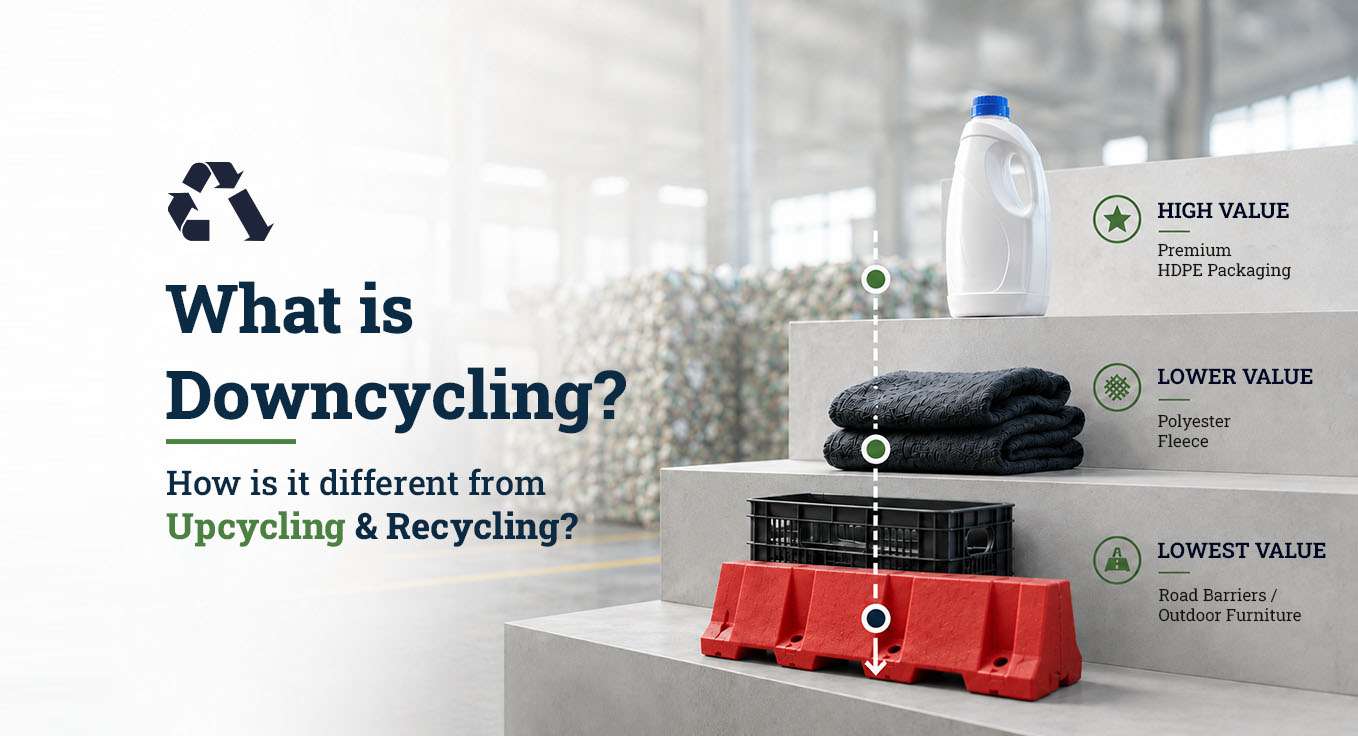
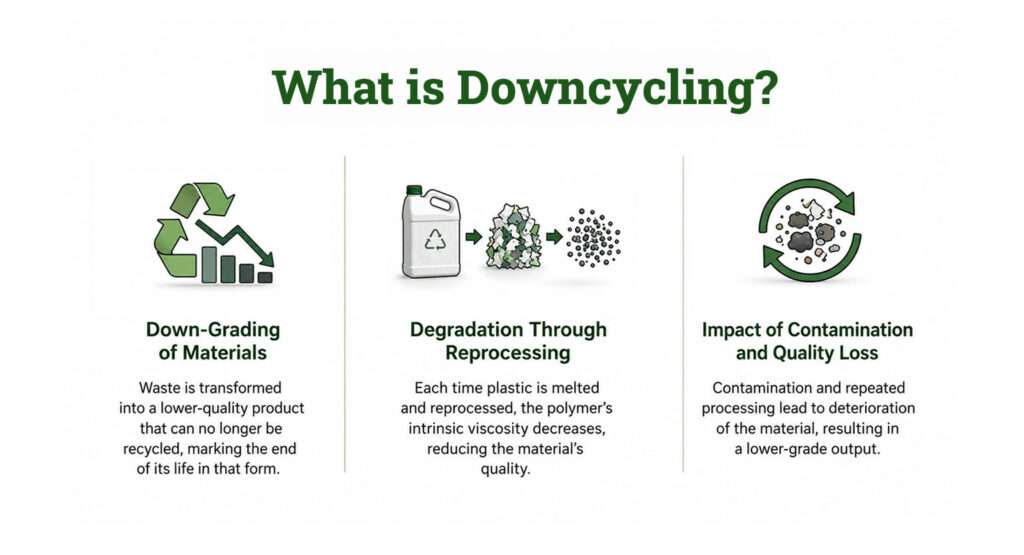
In order to understand what downcycling is you need to think about it as a down-grading. If the waste can go through this process, it is changed into a product that can usually no longer be recycled, which is therefore at the end of its life in its new form.
As far as what downcycling of plastic is specifically, it typically comes down to degradation of polymers and contamination. In an industrial context, every time a plastic bottle is melted, the material’s intrinsic viscosity decreases, answering the fundamental question: what is downcycling? It is the deterioration of a resource over time.
Process of Downcycling
Downcycling is a side-effect of the mixed waste collection program. The inevitable result of commingling different grades of waste is a mechanical downcycling since the physics of sorting limits the mechanical process.
Typical activities along process of downcycling are:
- Mixed Collection: Batch of plastics that contain a variety of types or qualities.
- Mechanical Shredding: Materials are chopped, but this may break the polymer chains or break paper fibers.
- Contaminated Washing: Washing of processing material with residual inks, labels or food scraps that cannot be fully removed.
- Low-Heat Compounding: Thick, dark pellets made by melting the mixed batch, which are only suitable for use in heavy-duty, low-aesthetic products.
Examples of Downcycling
There are countless examples of how waste can be downcycled in the real world within municipal waste streams. These are all examples of downcycling and show how high value items gradually move out of high value production loops.
Examples of downcycling include:
- Plastic Bottles to Fleece: High quality PET beverage bottles are transformed into polyester fibers that can usually not be recycled a second time and are used to create clothes.
- Writing Paper to Cardboard: Office paper of high quality that’s being recycled into egg cartons or industrial packaging.
- Melted Down Dashboard Composites and Bumpers to Highway Dividers: Car Plastics to Road Barriers.
Recycling vs Upcycling vs Downcycling
To build an effective waste strategy, companies must distinguish between the three pillars of resource recovery. The matrix below clarifies how these pathways differ based on the value and quality of the output material.
Feature | Upcycling | Recycling (Functional) | Downcycling |
Material Quality | Increases or stays premium | Remains identical | Decreases significantly |
Primary Output | Luxury or high-value items | Same product type (e.g., bottle to bottle) | Low-tier industrial goods |
Lifespan Impact | Extends lifecycle indefinitely | Maintains cyclic loop | Delays final landfill disposal |
Understanding recycling upcycling and downcycling helps brands realize that standard recycling often defaults to downcycling if the input streams are not strictly managed.
Role of Banyan Nation in Sustainable Plastic Recycling
The systemic issue – what is downcycling of plastic – is directly addressed by the Banyan Nation with high purity processing in the Indian market. Unlike traditional recyclers who have to settle for downcycling due to the inability to remove embedded odors, inks and mismatched polymers, Banyan Nation has proprietary cleaning and decontamination technologies that yield Better Plastic™.
We can help to ensure that the mechanical re-recycling of plastics, also known as downcycling, is avoided, allowing global FMCG brands to reuse post-consumer recycled plastic in premium packaging applications indefinitely, with the plastic being kept at its best.
Conclusion
Down cycling is a short-term solution to waste reduction in landfills but isn’t a long-term solution for a sustainable society. Industry can move closer to real closed loop recycling by defining downcycling and making an effort to overcome the root causes of material degradation. By adopting the most suitable technologies and focusing on material purity, we can overcome the constraints of downcycling, enabling waste to become a true – and lasting – resource for generations to come.
FAQ's
Why does downcycling reduce material quality?
Downcycling reduces material quality because the mechanical and thermal processes used during recycling physically shorten polymer chains (in plastics) or fibers (in paper), resulting in a weaker structural base.
What types of plastics are usually downcycled?
Highly contaminated plastics, mixed-color resins, and multi-layered packaging materials are the most common candidates for downcycling because separating them into pure streams is economically or technically unfeasible.
Which industries commonly use downcycling?
The construction, textile, and outdoor furniture industries frequently utilize downcycled materials to create items like plastic lumber, geotextiles, and industrial pallets.
How does downcycling impact the environment?
Downcycling has a positive short-term impact by reducing landfill volume and saving energy compared to virgin manufacturing. However, because the resulting products are often unrecyclable, it merely delays the eventual accumulation of waste.
Making recycled packaging the norm.
CITATIONS:
- Banyan Nation. (2026). Beyond Downcycling: Achieving True Value Retention in Plastics.
- Ellen MacArthur Foundation. The Limits of Mechanical Recycling and the Need for High-Purity Inputs.
- Journal of Cleaner Production. (2025). Comparative Analysis of Upcycling, Recycling, and Downcycling in Circular Economies.
- World Chemical Engineering Journal. Thermal Degradation Pathways of Post-Consumer Resins.
 What Is the Waste Disposal Hierarchy? 5 Steps Explained
 What Is ABS Plastic? Properties, Uses & Recycling
 International E-Waste Day 2026: What It Means and How to Take Part
 What is Waste Disposal: Methods, Types, and Real-World Examples
 What Is Polyolefin? Types, Properties, Uses and Recyclability