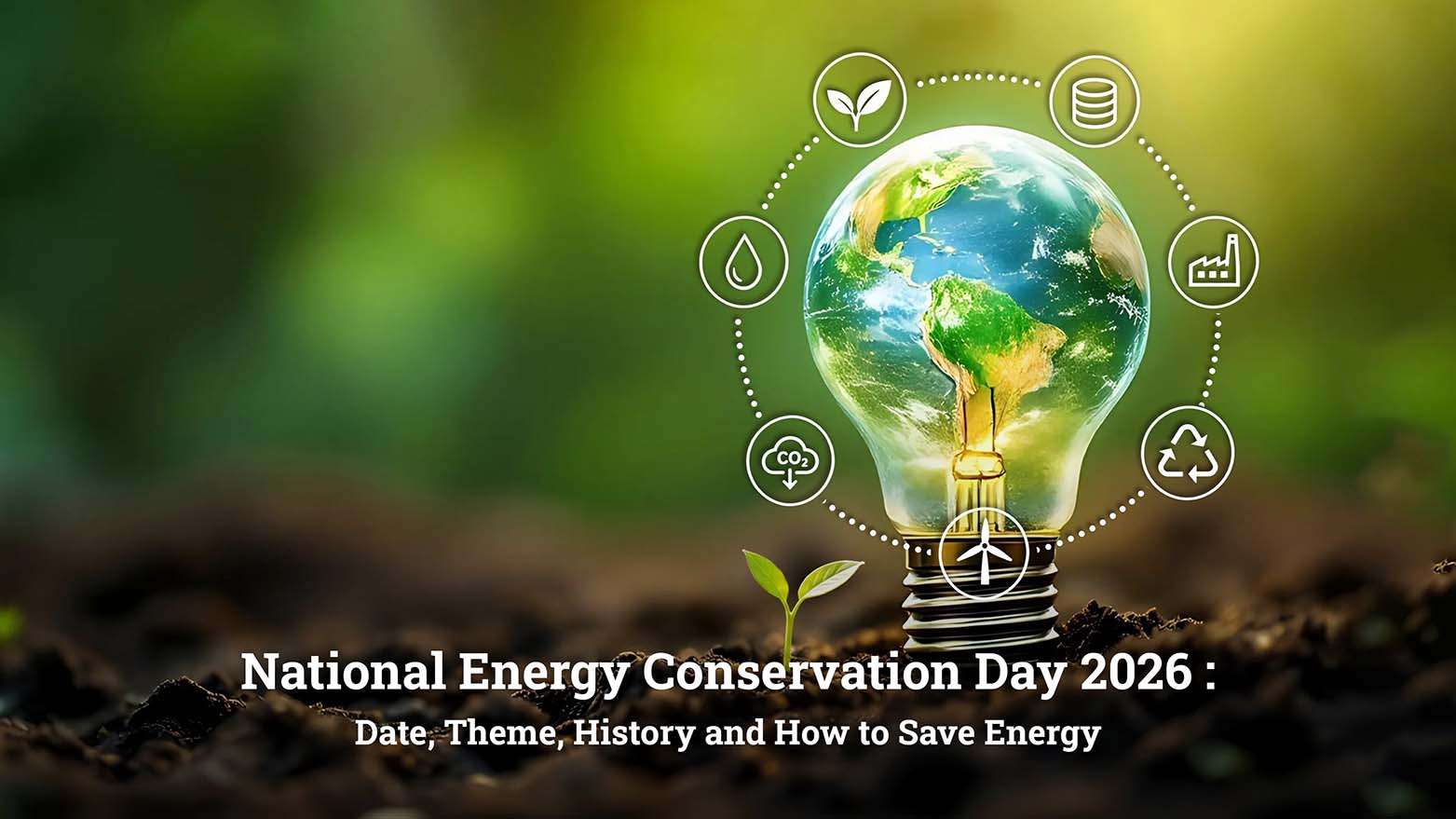
Every year on 14th December (Monday) in India, the National Energy Conservation Day is celebrated, and on this day, the Bureau of Energy Efficiency (BEE) under the Ministry of Power leads the celebrations. Every nation’s citizen, industry and institution is reminded through this day of the importance of energy conservation and need to minimize the wasteful use of energy for a sustainable India.
India’s economy is booming and the country’s electricity demand is also increasing above 1,800 Billion Units per year and conserving energy is no longer an option, but a need of the hour to reduce the emission of greenhouse gasses, conserve the limited fossil fuels and ensure energy security for the nation. Switching to 5-star rated appliances at home, to switching production methods to be more energy efficient in industry, to using recycled and re-used materials in the place of virgin materials, it all adds up to energy savings. From switching to 5-star rated appliances at home, to using energy-efficient production methods in industry, to using recycled and re-used materials instead of virgin materials, every saved watt matters.
From the history behind national energy saving day to simple, everyday steps you can take, Banyan Nation explains all the details about national energy saving day, its official theme, major national energy saving events in history and how you can save energy and carbon footprint every day.
What Is National Energy Saving Day and Why Is It Observed?
National Energy Saving Day is an annual day of awareness to promote responsible energy use and the use of energy efficient technologies in Indian households, commercial buildings and industries which is also known as Rashtriya Urja Sanrakshan Diwas in Hindi.
The aim of the energy saving day is to achieve the following:
- Public Awareness: Informing citizens and student of the need of not wasting electricity into the environment and the economy.
- Facilitate the efficient use: Promote the utilization of smart appliances, LED lights and energy management systems in the industry.
- Reducing Utility Bills: Assisting households and enterprises reduce their operational electricity and fuel bills by making simple behavioural changes.
- To ease fossil fuel energy generation, in order to lessen pollutions from the air and help fight climate change.
History of Energy Conservation Day in India
The beginnings of a formal process for conserving energy in India were laid down in 1991 with the introduction of the National Energy Conservation Day (NENC) and the very prestigious National Energy Conservation Awards (NECA) for industries that were doing exemplary work in conserving energy.
To provide these efforts with a legal framework, Parliament enacted the landmark Energy Conservation Act, 2001 and the Bureau of Energy Efficiency (BEE) was established on 1 March 2002. Since then, BEE has led the policy initiatives, appliance star ratings, and national awareness campaigns on 14 December, such as the National Painting Competition on Energy Conservation, which has engaged millions of school students in India every year since its inception.
Year | Key Milestone in India’s Energy Conservation Journey |
1991 | First National Energy Conservation Day observed; National Energy Conservation Awards (NECA) launched. |
2001 | Government of India enacts the Energy Conservation Act, 2001. |
2002 | The Bureau of Energy Efficiency (BEE) was formally established on 1 March under the Ministry of Power. |
2006 | BEE launches the Standards & Labelling (S&L) star-rating program for household appliances. |
2012 | Perform, Achieve and Trade (PAT) scheme introduced to mandate energy efficiency in heavy industries. |
2025 | Energy-intensive sectors transition from PAT to the Carbon Credit Trading Scheme (CCTS). |
National Energy Conservation Day 2026 Theme
National Energy Conservation Day was highlighted by the Press Information Bureau (PIB) and Ministry of Power under the theme “Saving Energy, Securing Future” in 2025, underscoring the importance of energy efficiency for India’s economic development and climate actions.
The official theme of National Energy Conservation Day 2026 will be updated here as soon as the theme is officially announced by the Bureau of Energy Efficiency (BEE) or Ministry of Power before 14 December. The underlying objective, whatever the annual ‘slogan’ may be, is the same: to separate economic growth from the unnecessary consumption of energy through energy efficiency, energy innovations and sustainable energy use habits.
National vs World Energy Conservation Day: Is There a Difference?
Many people find the term world energy conservation day or international energy conservation day and think that 14 December is a United Nations day. It’s a fact that 14 December is a national day only celebrated in India and is organised by BEE. World energy conservation day is different from World Energy Day on 22 October, which is observed throughout the world, but is often referred to as “World” or “International Energy Conservation Day” in international blogs.
Feature | National Energy Conservation Day | World Energy Day |
Date | 14 December (Annual) | 22 October (Annual) |
Scope | India-specific national observance | Global observance |
Organizing Body | Bureau of Energy Efficiency (BEE), Ministry of Power | World Energy Forum (endorsed globally) |
Primary Focus | Demand-side energy efficiency, appliance ratings, and cutting power wastage | Equitable global access to clean, sustainable energy sources |
Why Energy Conservation Matters for India: Key Stats
India, one of the largest energy consumer countries in the world, has set its power generation target, for 2025-26, at 2,000.4 Billion Units (BU). Nationwide energy efficiency initiatives help to reduce carbon emissions by billions of tonnes and avoid expensive power plant additions.
National Program / Initiative | Key Energy-Saving Impact | Official Source |
UJALA Scheme | More than 36.87 crore LED bulbs have been distributed and approximately 47,883 million kWh of electricity has been saved annually. | Ministry of Power / EESL |
Standards & Labelling (S&L) | Appliances include 38+ categories and leads consumers to 5-star rated appliances, saving billions of units each year. | Bureau of Energy Efficiency (BEE) |
PAT & CCTS Mechanism | In 2025, introduced the Carbon Credit Trading Scheme (CCTS) to bring efficiency into the equation with emission reductions, and transitioned heavy sectors like cement, aluminium, petrochemicals, and textiles from PAT to CCTS. | Press Information Bureau (PIB) |
PM Surya Ghar Mission | By the end of 2025 added 7 GW of rooftop solar capacity and connected almost 24 lakh households. | PIB / Ministry of New & Renewable Energy |
How to Save Energy at Home, School and Work (Step-by-Step)
So, if you can adopt some practical measures to save energy throughout the day, you will be able to save money on your electricity bills, as well as reduce strain on the national power grid:
- Use 5-star BEE appliances and LED lights: Save up to 75% energy used with LED lights and 5-star BEE appliances like refrigerator, fans and ACs.
- Keep AC set at 24°C instead of 18°C – This can cut down on the cooling electricity usage by 24% to 36% without sacrificing comfort.
- Power down the Vampire: Standby mode is responsible for consuming up to 10% of the power in your home, so unplug chargers, microwaves, game consoles and TVs at the wall switch.
- Make the most of natural daylight and ventilation: Open blinds and curtains during the daylight hours and not all day long by using artificial overhead lighting.
- Continue to maintain Vehicles & Use Public Transit: continue to keep tires inflated, continue to service engines on schedule, and car pool or use metro/bus transit to conserve fossil fuels.
- Select Products in Recycled Packaging: Making products with recycled plastic uses significantly less industrial energy than deriving virgin petrochemicals.
Students: Students can take the lead to turn off the classroom fans and projectors during breaks, arrange for energy conservation poster competitions and organize an electricity consumption audit in the classroom to encourage students to adopt a habit of conserving electricity from an early stage.
How Recycling Plastic Helps Conserve Energy
Saving energy is not just about turning the lights off, it’s in the materials we make and purchase. The manufacture of virgin plastic from crude oil and natural gas is very energy intensive and requires thermal steam cracking, catalytic polymerisation and refining.
The Association of Plastic Recyclers (APR) and the U.S. Environmental Protection Agency (EPA) data also indicate that recycled polyethylene (rPE) and recycled polypropylene (rPP) can be used to make certain products with up to 66% to 88% less energy used than virgin resin from fossil feedstocks. The diversion from a landfill, and mechanical recycling of every single plastic bottle or rigid container, saves the raw fossil energy and upstream greenhouse gas emissions. To learn more about the various ways polymers can be recovered and the various effects that the choice of polymer has on emissions, types of plastic recycling and what a carbon footprint is.
Banyan Nation’s Role in Energy-Efficient, Circular Plastics
One of the best opportunities for consumer brands to reduce the embodied energy and embodied carbon footprint of their packaging is to close the loop. Banyan Nation is one of the first vertical plastic recycling facilities to convert post-consumer polyethylene (PE) and polypropylene (PP) waste into high purity, near virgin grade recycled resin (Better Plastic™).
Banyan Nation provides proprietary data-driven collection networks, hot-wash decontamination and precision compounding to help top FMCG, automotive and industrial brands switch from energy-hungry virgin fossil plastics without compromising on packaging functionality. Enterprises can greatly lower Scope 3 energy and carbon indicators, and comply with statutory compliance requirements, by incorporating traceable secondary raw materials into their production lines. Discover our recycled polyethylene (rPE) resins and comprehensive Extended Producer Responsibility (EPR) solutions to build an energy-efficient circular supply chain.
FAQ's
When is National Energy Conservation Day celebrated and why?
National Energy Conservation Day or World energy saving day is celebrated in India every year on 14 December (Monday in 2026). Organized by the Bureau of Energy Efficiency (BEE), it raises nationwide awareness about reducing energy wastage, adopting efficient technologies, and securing sustainable development.
What is the theme of National Energy Conservation Day 2026?
While the 2025 observance is centered on “Saving Energy, Securing Future”, the official theme for National Energy Conservation Day 2026 will be announced by the Bureau of Energy Efficiency (BEE) and the Ministry of Power closer to 14 December.
Who organises National Energy Conservation Day in India?
National Energy Conservation Day is organized by the Bureau of Energy Efficiency (BEE), a statutory body operating under the Ministry of Power, Government of India.
What are the easiest ways to save energy at home?
The easiest ways to save energy at home include setting air conditioners to 24°C, replacing old bulbs with LED lighting, switching off appliances at the wall socket to stop standby power drain, maximizing natural sunlight, and upgrading to 5-star BEE-rated appliances.
How does recycling plastic save energy?
Mechanical plastic recycling eliminates the energy-intensive extraction and steam-cracking of crude oil and natural gas. Producing recycled HDPE and PP resins consumes up to 66% to 88% less energy than manufacturing virgin plastic from scratch.
Making recycled packaging the norm.
Connect with our sales team to find out which recycled resin is right for you.
CITATIONS:
- Press Information Bureau (PIB), Ministry of Power. (2025). National Energy Conservation Day: Saving Energy, Securing Future & Transition from PAT to Carbon Credit Trading Scheme (CCTS). Government of India.
- Bureau of Energy Efficiency (BEE). (2025). Impact Assessment of Energy Efficiency Programs: UJALA, Standards & Labelling, and National Energy Conservation Awards (NECA). Ministry of Power, Government of India.
- Association of Plastic Recyclers (APR) & Franklin Associates. (2023). Life Cycle Impacts for Postconsumer Recycled Resins: PET, HDPE, and PP Energy & GHG Emissions.
 National Energy Conservation Day 2026: Date, Theme, History and How to Save Energy
 National Pollution Control Day 2026: Date, Theme, History and How to Take Part
 What Is Mono Material Packaging? Benefits for Recyclability
 What Is a Recycle Bin? Meaning, Colours & Types
 What Is the Waste Disposal Hierarchy? 5 Steps Explained