With resource scarcity and carbon accounting in the industrial world, there is a need to consider the variety of plastic recycling processes before modern product design can be circular. For many years, global supply chains have been operating in a linear way, producing and using single-use synthetic polymers in their one-way cycle that ended up in municipal landfills. For sustainable manufacturing today, a comprehensive knowledge of polymer chemistry, polymer decontamination and the processing methods is required. Understanding what are recycled plastics relies not only in identifying sorted waste, but also understanding the processes of recovering and reprocessing post-consumer and post-industrial polymers back to industrial feedstock. New and increasingly sophisticated recovery technologies make it possible to produce high-purity recycled resins, while maintaining the same durability and tensile strength as virgin fossil-based resins. The landscape around Extended Producer Responsibility (EPR) requirements, consumer choices and carbon taxation is changing globally, and it is important to understand what are recycled plastics?, the various forms of plastic recycling to help mitigate supply-side shocks and regulations on brands. The businesses of a future ready sector can progressively decrease their Scope 3 GHGs, protect natural ecosystems, and establish an eco friendly manufacturing system that is resource limited.
Introduction
Closed-loop material cycles are a crucial step in the transformation of industrial facilities to real eco friendly manufacturing. Brands are aware of what are recycled plastics?, the need to use high purity, traceable recycled polymers throughout their entire range when they assess their production processes and determine it to be truly eco friendly manufacturing.
Organizations can:
- Lower Carbon Footprints: The energy required for processing secondary polymers is up to 80% less than that needed for crude oil to produce virgin plastics.
- Ensure Regulatory Compliance: Comply easily with national EPR rules and prevent potentially steep non-compliance penalties.
- Improve Supply Chain Resilience: Ensure reliable supplies of raw materials that are not sensitive to global oil prices and are concentrated at a specific location.
What is Plastic Recycling? (And Why the Type Matters)
There are different types of plastic recycling. The mechanical, thermal or chemical reprocessing of waste synthetic polymers to produce raw feedstock for industrial production is the essence of plastic recycling. However, recycling all plastics as a homogeneous material stream is one of the main reasons why most recycling schemes are unsuccessful.
Resin families are not compatible when processing because they melt at different temperatures, have different molecular weights, and/or different chemical structures, which causes the material batch to be ruined. The knowledge of the different types of plastic recycling enables the classification of plastics, cleaning, and processing in a way that allows the production of high-quality materials and compounds for strict manufacturing needs.
Two Main Categories of Plastic Recycling
Within the plastic recycling industry, there are two major categories of plastic recycling recovery paths based on the types of plastic recycling technology used: Mechanical and Chemical (Advanced) recycling.
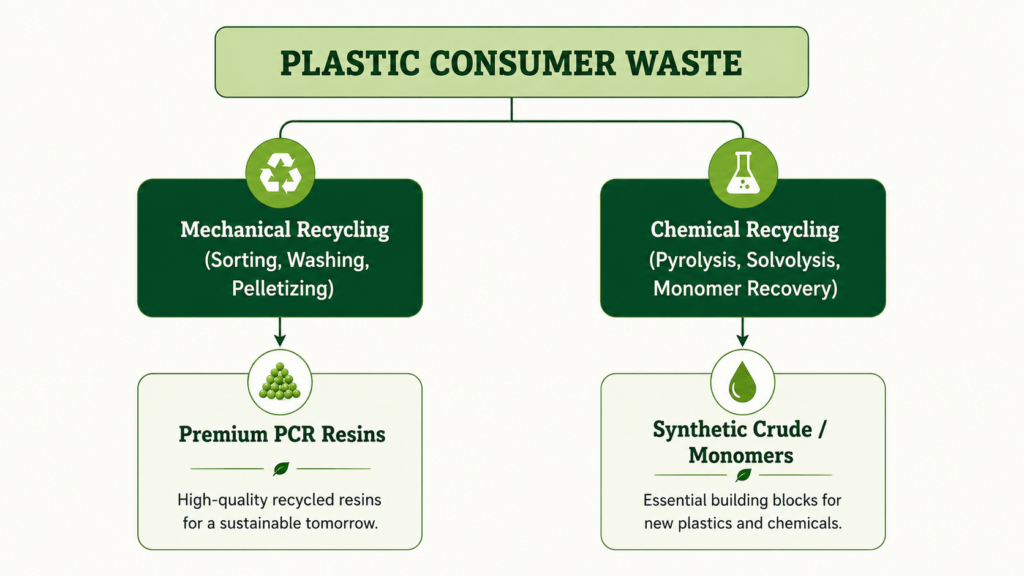
- Mechanical Recycling: Most popular and energy efficient pathway. The plastic is picked up, sorted by resin type, washed, chopped into smaller even-sized pieces and reprocessed into new pellets in a controlled heat process.The plastic is collected, separated into resin types, cleaned of impurities, chopped into a uniform small size and extruded under controlled heat conditions into new plastic pellets.
- Chemical Recycling: Collection of advanced plastic recycling processes (including depolymerization, gasification and pyrolysis which convert polymer chains into basic monomers or synthetic crude oil. This allows multi-layer films to be recycled back to virgin polymers even if they contain contaminants or other materials that can be recycled, but would not be separated.
There are different types of plastic recycling streams in industries that can be addressed using categories of plastic recycling; mechanical and chemical processing.
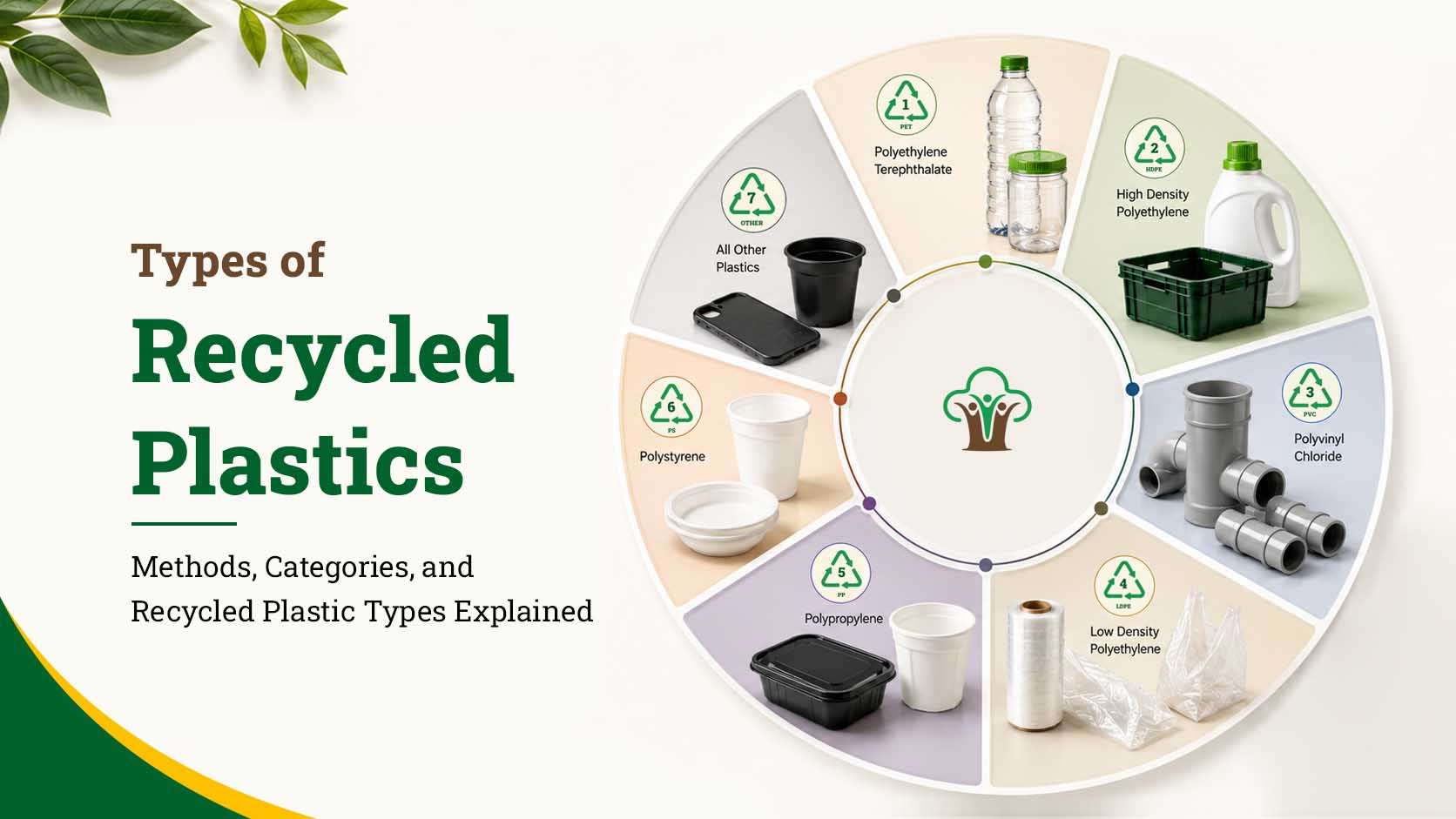
7 Types of Recycled Plastics – Resin Codes Explained (1–7)
A system to maximize purity throughout the recovery process was developed by the Society of the Plastics Industry (SPI) with their Resin Identification Code (RIC) system. If these types of recycled plastics are not understood, then material recovery will not be effective.
Let’s now look at the different types of recycled plastics.
1 PET (Polyethylene Terephthalate)
It is commonly used in beverage bottles, packaging for foods and synthetic fibers. PET is one of the most widely recycled plastics in the world due to its high clarity, gas barrier properties and its excellent mechanical processability to new food-grade containers or polyester textiles.
2 HDPE (High-Density Polyethylene)
Milk jugs, shampoo bottles, detergent packing and industrial crates are examples of uses for HDPE, which has an outstanding strength-to-density ratio. Mechanical recycling lines are easily able to process HDPE and produce high quality pellets for blow-moulding and injection moulding.
3 PVC (Polyvinyl Chloride)
A hard plastic material that is used for plumbing pipes, window frames, cable insulation and medical tubing. Recycling PVC may be challenging due to the presence of harmful gases and corrosive properties during the recycling process and the high chlorine content of PVC that may contain potentially hazardous additives.
4 LDPE (Low-Density Polyethylene)
A soft polymer that can be applied to a squeeze bottle, an agricultural film, or trash bags or flexible packaging wraps. Although mechanically recoverable, LDPE processing calls for special washing and pelletizing lines as the thin, stretchable film does not jam the machines.
5 PP (Polypropylene)
PP has a high melting point, it is chemically resistant and it is used to make a wide range of products such as yogurt tubs, automotive battery cases, containers for microwave and bottle closures. High grade PCR resins can be re-engineered using advanced decontamination processes for challenging applications using PP.
6 PS (Polystyrene)
Rigid forms, such as plastic cutlery, CD cases; expanded foam forms (Styrofoam). The mechanical recycling of PS is challenging because of its low density and susceptibility to contamination, and often can only be processed chemically or thermally through the densification process.
7 Other Plastics
This is an umbrella term that refers to multi-layer laminates, polycarbonate, acrylic and bio-based plastics (such as PLA). This group is a mixture of polymer structures, which requires advanced optical sorting technology or a specially-coded chemical recycling procedure.
Which Plastics Are Most Commonly Recycled?
All polymers are technically suitable to be processed with the right technology, but PET
(RIC 1) and HDPE (RIC 2) account for the bulk of the polymers processed worldwide. Both of these resins have well-established collection systems, are easily processable, and have demand from major consumer goods companies.
Flexible films (LDPE) and rigid containers (PP) on the other hand are growing quickly as mechanical recycling technology advances; PVC, PS and complex multi-layer plastics (RIC 7) continue to be more difficult, because of economic and technical challenges.
What Are the Benefits of Using Recycled Plastics?
The benefits of incorporating verified secondary polymers go beyond ensuring compliance with environmental standards, offering distinct structural benefits to manufacturing processes. High purity PCR resins are useful for both environmental and operational parameters.
Key benefits include:
- Savings in Crude Oil: For every ton of post-consumer plastic processed directly, a ton of fossil fuel is less required to make virgin resin.
- Reducing Energy Needs: Secondary pellets use only a small fraction of the energy needed in petrochemical synthesis.
- Large-scale Landfill Avoidance: Removing large amounts of non-biodegradable packaging from landfills reduces future contamination of the environment.
- De-Risking Supply Chains: Supplies help manufacturers prevent supply disruption and crude oil price volatility in foreign markets.
How Banyan Nation Enables Eco-Friendly Manufacturing
Banyan Nation tech helps lower manufacturing costs without compromising on the environment. The main factor that has limited the use of recycled resins for global brands has been the purity gap: post-consumer waste typically contains microscopic contaminants and/or unpleasant odors, and their colour is more or less variable than that of virgin materials.
Here at Banyan Nation we do both, with a digitally traceable supply chain that’s supported by the latest in mechanical hot-washing and scientific decontamination technologies. Our proprietary processing technology turns post-consumer polyolefin (HDPE and PP) into Better Plastic™, a range of near-virgin quality PCR resins.
Our PCR granules provide consistent melting characteristics, high tensile strength and odour-free quality, and can easily be integrated into current high-speed blow-moulding and injection-moulding lines, enabling major brands in FMCG, Automotive and Industrial applications to comply with their EPR objectives and reduce dependence on virgin plastics.
Conclusion
The knowledge of the different plastic recycling types, types of recycled plastic and is the base of modern, circular manufacturing. Industries can systematically remove the waste by understanding how to use the properties of the seven resin codes along with advanced mechanical and chemical recovery processes. By moving away from linear design processes and towards clean and traceable secondary resins, our manufacturing systems can create a future that is sustainable, with a lower carbon footprint and a better protection of natural resources.
FAQ's
What are the 3 main types of plastic recycling?
There are three main types of plastic recycling. Mechanical Recycling – (sorting, washing, shredding and melting plastics into new pellets); Chemical Recycling (processes of heat and/or chemicals to break down polymer chains into basic monomers or synthetic fuels); and Thermal Recycling (process of burning non-recyclable plastics under controlled conditions to recover energy (electricity generation).
Which type of plastic is easiest to recycle?
The t easiest and most economical plastics to recycle are PET (Polyethylene Terephthalate, RIC 1) and HDPE (High-Density Polyethylene, RIC 2). They have proven collection streams, defined chemical profiles and high market demand for their recycled versions.
What is the difference between mechanical and chemical recycling?
There are different types of plastic recycling techniques. Mechanical recycling: Melting and reshaping plastics into new granules without changing their molecular structure. Chemical recycling involves breaking polymer chains back down into the original polymer building blocks – raw monomers – through chemical reactions or high-temperature processes, enabling multi-layer or contaminated plastics to be repurposed into virgin quality feedstock.
Which plastics cannot be recycled?
Polyvinyl Chloride (PVC, RIC 3), Polystyrene/Styrofoam (PS, RIC 6), thermosetting plastics (which cannot melt when heated) and multi-material laminate pouches, which are pouches of several different polymer layers fused together, are extremely difficult or impossible to recycle mechanically.
What does Banyan Nation recycle and what products do they make from it?
Banyan Nation’s specialty is recycling of Post-Consumer polyolefins, including High-Density Polyethylene (HDPE) and Polypropylene (PP). These waste materials are transformed into the line of Better Plastic™ near-virgin quality PCR HDPE and PCR PP granules, which are suitable for FMCG, industrial brands and manufacturers to create shampoo bottles, detergent jugs, personal care packaging and industrial containers.
Making recycled packaging the norm.
CITATIONS:
- Association of Plastic Recyclers (APR). Model Design Guide for Plastic Recyclability and Polymer Purity Standards.
- Ministry of Environment, Forest and Climate Change. (2026). National Framework for Plastic Waste Management and Extended Producer Responsibility (EPR) Verification.
- Journal of Applied Polymer Science. Comparative Thermal Analysis and Mechanical Degradation Behavior of Virgin vs. PCR HDPE Resins in Multi-Cycle Processing.
 Life Cycle Assessment (LCA): Steps, Phases, Standards & a Real Example
 Types of Plastic Recycling: Methods, Categories, and Recycled Plastic Types Explained
 How Upcycling Plastics Supports a Circular Economy
 World Nature Conservation Day 2026: Date, Theme, History & Why It Matters
 Sustainable Packaging Solutions: Materials, Benefits, and How to Make the Switch