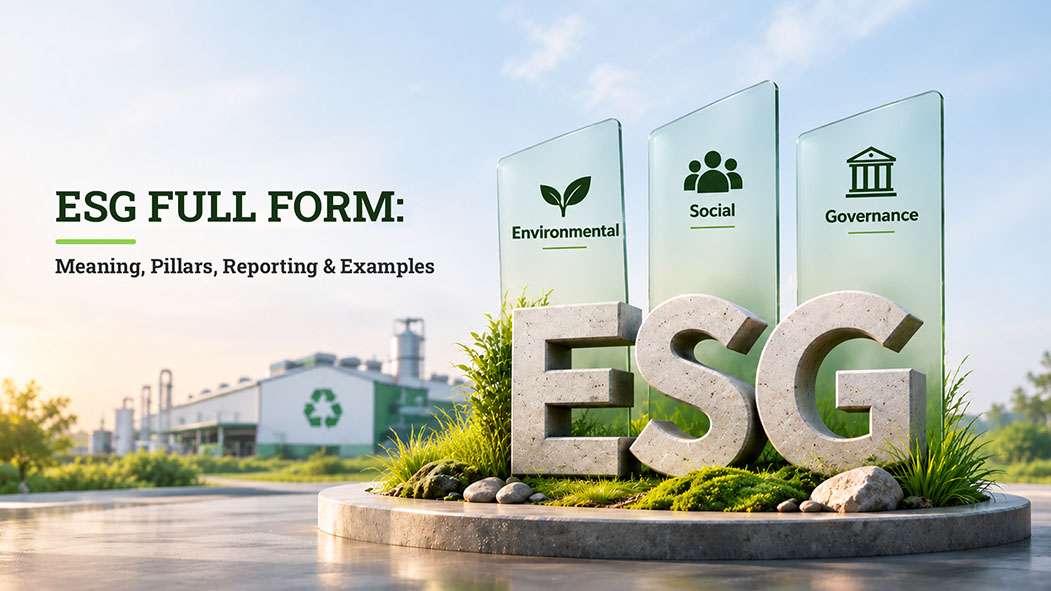
ESG Full Form stands for “Environmental, Social and Governance,” and it is a set of metrics that allow investors to assess a company’s responsibility and sustainable practices, as well as its ethical behavior. Across the cube of economy, social and governance issues, ESG is not, can’t and won’t be about the quarterly bottom line, but about providing investors, regulators and consumers with tangible signs of non-financial risk buttered with stoodrope resilience rather than ethical value creation over a lifetime.
Understanding ESG full form, ESG meaning and what is ESG is vital for modern businesses in India and all over the world as modern strict climate regulations are increasingly being set, and transparency is also becoming more important in global supply chains. Environmental, social and governance (ESG) data turns to business data from scope 1, 2 and 3 carbon emissions to fair labor practices from tier 1 to 2 to 3 manufacturers, to independent board of directors.
Consumer brands, market-leading manufacturers of packaging and packaging equipment are directly affected by their ESG performance, e.g., access to green capital, implementation of SEBI’s Business Responsibility and Sustainability Reporting (BRSR) Regulations, and inclusion in international contracts of supply-chain agreements. In this comprehensive guide, Banyan Nation discusses the meaning of ESG, also explains the three pillars of ESG with examples from India, compares ESG with CSR and provides an insight on how circular materials contribute to measurable ESG goals of brands.
What Is ESG? A Simple Definition
Let’s understand first what is ESG? Aligning environmental, social and governance principles to the core business strategy has measurable financial and operational benefits:
- Preference in Financing: Companies with a high ESG rating receive preferential financing, green bonds or institutional finance from dedicated sustainability funds.
- Minimize Regulatory & Reputational Risk: Be proactive to protect against costly fines for environmental offences, product ban and public reputation risks due to environmental greenwashing and labour risks.
- Global brands are increasingly asking India suppliers for the carbon footprint and recycled content for giving them their B2B business contracts.
- Operational Cost Savings: Save energy, water, and raw material consumption with positive results on the bottom line.
- Talent Attraction & Retention: Lower attrition and higher employee engagement with younger employees at purpose-driven workplaces.
- The soaring capital flow into sustainable businesses is expected to reach $33.9 trillion of themed AUMs according to the report Asset and Wealth Management Revolution, by PwC.
The Three Pillars of ESG Explained (E, S and G)
Though thought to be used synonymously at times, ESG and Corporate Social Responsibility (CSR) have different roles in corporate governance in India:
Pillar | What It Covers | Example Metrics | India-Relevant Example |
Environmental (E) | Carbon emissions, energy efficiency, water conservation, waste management, and plastic circularity | Scope 1, 2 & 3 GHG emissions (tCO2e), renewable energy share (%), post-consumer recycled (PCR) plastic % | An FMCG brand replacing virgin HDPE shampoo bottles with 50% recycled resin to cut packaging emissions and meet EPR targets. |
Social (S) | Fair labour practices, workplace health and safety, diversity & inclusion, and community welfare | Lost Time Injury Frequency Rate (LTIFR), gender pay gap, living wage compliance, supplier safety audits | A recycling enterprise integrating informal waste pickers into formal supply chains with fair pricing, PPE gear, and bank access. |
Governance (G) | Board independence, business ethics, anti-corruption, shareholder rights, and data privacy | Independent director ratio (%), whistleblower policy effectiveness, cybersecurity compliance, executive pay alignment | A listed Indian corporation publishing audited BRSR Core disclosures with independent board oversight on climate risk. |
Why ESG Matters for Businesses and Investors
Aligning environmental social and governance investing principles to the core business strategy has measurable financial and operational benefits:
- Preference in Financing: High ESG rated companies gain preferential financing, green bonds, and institutional finance from dedicated sustainability funds.
- Reduce Regulatory & Reputational Risks: Avoid costly fines for environmental violations, ban on products and public concerns about greenwashing or labour violations by being proactive.
- Global brands are increasingly demanding carbon footprints and recycled content from Indian suppliers for awarding B2B contracts.
- Operational Cost Savings: Less energy use, water waste and reliance on virgin raw material boosts profits.
- Talent Attraction & Retention: Purpose-driven workplaces have lower attrition and higher employee engagement with younger employees.
Global ESG themed AUMs are expected to grow to $33.9 trillion as shown by PwC’s Asset and Wealth Management Revolution report, highlighting the speed of capital flow towards sustainable businesses and environmental social and governance investing.
ESG vs Sustainability vs CSR: What’s the Difference?
While often used interchangeably, ESG in sustainability/ ESG sustainability and Corporate Social Responsibility (CSR) serve distinct roles in Indian corporate governance:
Dimension | ESG | Sustainability | CSR (Corporate Social Responsibility) |
Meaning | Quantifiable framework measuring environmental, social, and governance risks/impacts | Broad philosophy of operating without depleting resources for future generations | Voluntary or mandated philanthropic initiatives supporting social welfare |
Core Focus | Risk management, operational metrics, and investor-grade data | Long-term ecological and societal balance across the business model | Community development, education, healthcare, and charitable giving |
Who It Serves | Investors, regulators, lenders, customers, and stakeholders | Planet, society, and long-term business viability | Local communities and society at large |
Measurability | Highly standardized, auditable KPIs and ratings | Qualitative vision paired with broad goals | Tracked via project spend and beneficiary reach |
Mandatory in India? | Mandatory BRSR reporting for top 1,000 listed companies by market cap | Voluntary overarching corporate commitment | Mandatory under Section 135 of the Companies Act, 2013 (2% of average net profit for eligible firms) |
ESG Reporting in India: SEBI’s BRSR and BRSR Core
SEBI regulates environmental social and governance policy reporting in India. The Securities and Exchange Board of India (SEBI) has published the Business Responsibility and Sustainability Report (BRSR) with the Annual report on the top 1,000 listed companies by market capitalization based on the 9 Principles of the National Guideline on Responsible Business Conduct (NGRBC) for the year from FY 2022-23.
To ensure pertinent data and to avoid ‘greenwashing’, SEBI released a focused subset of Key Performance Indicators (KPIs) across nine ESG attributes (including GHG footprint, Water footprint, Energy intensity, Circularity/ Waste management, Employee well being and others), for environmental social and governance policy reporting through a phased glide path with reasonable assurance.
- FY 2023–24: Top 150 listed entities
- FY 2024–25: Top 250 listed entities
- FY 2025–26: Top 500 listed entities
- FY 2026–27: Top 1,000 listed entities
The revised search engine value-chain framework has been released by the SEBI which made the disclosure regarding ESG condition voluntary and will be gradually phased-in assurance over the next FY 2026-27 for the listed Top 250 companies under the value-chain framework.
Major ESG Frameworks and Standards (GRI, ISSB, SASB, TCFD and BRSR)
International and national frameworks and standards for enhanced reporting on ESG are available. Consideration was also given to the concepts of the Task Force on Climate-related Financial Disclosures (TCFD) that officially ended in late 2023 and have been incorporated into the IFRS S2 (ISSB) standards.
Framework / Standard | Issued By | Best For |
GRI (Global Reporting Initiative) | Global Sustainability Standards Board (GSSB) | In-depth reporting on the societal, economic and environmental impacts of activities to stakeholders.Reporting, across economic, environmental, and social issues, of a comprehensive multi-stakeholder impact report. |
ISSB (IFRS S1 & S2) | International Sustainability Standards Board | Financial materiality/TCFD Investor focused financial related risk disclosure |
SASB Standards | Value Reporting Foundation / IFRS Foundation | 77 industry-specific financial materiality metrics |
TCFD (Folded into ISSB) | Financial Stability Board (now managed by IFRS) | Climate governance, strategy, risk management and Scope 1-3 targets has been structured. |
BRSR & BRSR Core | Securities and Exchange Board of India (SEBI) | The Environment and Social Governance framework that companies on the listing market in India are required to abide by. |
Common ESG Goals with Examples
Organizations put their environmental social and governance (ESG) approach or ESG sustainability into practice through targets in each category: Environmental, Social and Governance.
Pillar | Common ESG Goal | Real-World Style Example |
Environmental | Achieve net-zero Scope 1 & 2 emissions by 2040 | Migrating 100% to COER towards 100% captive Solar and wind power across all the manufacturing plants in Maharashtra and Gujarat. |
Environmental | Incorporate 30% recycled content in rigid packaging | Use of certified post-consumer recycled resin used to replace virgin HDPE in engine oil and detergent bottles. |
Environmental | Achieve Zero Waste to Landfill across facilities | Separating 100% of industrial scrap and working with authorised recyclers to recover materials. |
Social | Zero workplace fatalities and living-wage parity | Regular 3rd party safety checks at each contract factory site with 100% compliance of living wage. |
Governance | Maintain ≥50% independent board representation | Designating independent directors as chairpersons of the Audit Committee and the Sustainability Risk Committee. |
ESG Investing and ESG Funds in India
ESG investing takes environmental, social and governance (ESG) data into account in addition to traditional financial metrics when making stock or bond selections. Institutional investors look for companies that have strong disclosures, third-party ESG ratings, and are free from controversy, while at the same time avoiding sectors that are likely to be negatively impacted by the transition to a low-carbon economy, such as thermal coal or tobacco.
For retail and institutional investors in India, they can purchase ESG funds in the SEBI-regulated ESG mutual fund category, enabling them to have a sustainable portfolio. SEBI requires ESG schemes to invest a minimum of 80% of their funds in the companies that have adhered to BRSR disclosures and classifies funds into different strategies like Exclusion, Integration, Best-in-Class, Impact Investing, and Sustainable Objectives.
But greenwashing (when businesses make exaggerated claims without measurable data) continues to be an investor worry. As a result, regulators and fund managers are increasingly requiring third-party assured and traceable supply-chain data before putting their environmental social and governance funds to use.
How to Build an ESG Policy for Your Company (Step-by-Step)
Developing a convincing ESG policy or environmental social and governance standard is a process that needs to be executed in a structured way, both in terms of operations and leadership:
- Conduct a Materiality Assessment: Determine the ESG issues that are most pertinent to your industry and audiences – for instance, for an FMCG brand, plastic packaging waste; for a textile brand, water intensity.
- Set Measurable, Time-Bound Targets: Identify clear KPIs (such as reducing Scope 3 emissions by 25% or increasing plastic usage to 30% by PCR by 2028) in compliance with national targets.
- Ensure Board-level Ownership: Create a Board of Directors Sustainability or ESG Committee to monitor progress and approve budgets.
- Collect Data Across the Value Chain: Develop digital tracking systems that capture data on energy, water, waste and supplier compliance from Tier-1 and Tier-2 partners.
- Select the Reporting Framework: Map disclosures to Indian Compliance – SEBI BRSR Core and Global Investors – GRI/ISSB.
- Publish and Obtain Third-Party Assurance: Report on sustainability annually, and use third-party auditors to ensure that there is no green washing and data is accurate.
How Recycled Plastic Helps Brands Meet ESG and EPR Targets
Virgin plastic manufacturing is one of the primary sources of Scope 3 GHG emissions for consumer goods, automotive, and packaging companies. Virgin fossil-derived plastic to post-consumer recycled (PCR) plastic.Transitioning to post-consumer recycled (PCR) plastic is tangible progress that meets multiple ESG metrics.
Recycled PE (rPE) and Recycled PP (rPP) can be used to make packaging, which can reduce up to 66% to 88% in energy requirements as compared to virgin petrochemicals, directly cutting into product carbon footprints. At the same time, integrating PCR resins meets the minimum recycled content requirements stipulated in the Plastic Waste Management Rules, as well as providing auditable circularity data to be included in the BRSR Core environmental disclosures. Learn how material selection may affect emissions by reading our guides on life cycle assessment (LCA) and what a carbon footprint is.
Banyan Nation’s Role in Helping Brands Achieve ESG Goals
The goal of ambitious ESG objectives requires verified and traceable secondary raw materials and not unverified paper offsets. Banyan Nation is a vertical plastic recycling pioneer in India that enables some of the country’s top FMCG, personal care and lubricant brands to close the loop on rigid plastic packaging.
Banyan Nation’s proprietary data driven collection networks, hot-wash decontamination and precision compounding process transform post-consumer polyolefin waste into “Better Plastic™”, which are near-virgin food and cosmetic grade recycled resins. Banyan Nation offers brand level traceability, life-cycle emissions data, and a reliable PCR supply at industrial scale, enabling brands to decrease Scope 3, and meet statutory EPR requirements with ease. Learn about our recycled polyethylene (rPE) resins and end-to-end Extended Producer Responsibility (EPR) solutions to strengthen your ESG performance.
FAQ's
What is the full form of ESG?
The ESG full form is the Environmental Social and Governance framework. It is a standardized corporate framework used to measure a company’s environmental impact, social responsibility toward workers and communities, and ethical governance practices.
What is the difference between ESG and CSR?
ESG or Environmental Social and Governance framework measures how sustainability risks and ethical practices are integrated into a company’s core business operations using investor-grade metrics. CSR (Corporate Social Responsibility) focuses on philanthropic community welfare projects, which are mandatory under Section 135 of India’s Companies Act, 2013 for qualifying companies.
Is ESG reporting mandatory in India?
Yes, for large listed firms. Under SEBI regulations, environmental social and governance reporting via the Business Responsibility and Sustainability Report (BRSR) is mandatory for the top 1,000 listed companies in India by market capitalization, with phased third-party assurance required under BRSR Core.
What are the 3 pillars of ESG?
The three pillars of ESG are Environmental (climate emissions, energy, water, waste, and plastic circularity), Social (worker safety, fair wages, diversity, and community impact), and Governance (board independence, ethics, transparency, and data security).
How can a company improve its ESG score?
A company can improve its ESG score by conducting a materiality assessment, cutting Scope 1–3 emissions through renewable energy and recycled packaging, ensuring transparent supply-chain labour audits, maintaining an independent board, and publishing third-party assured BRSR or GRI disclosures.
Making recycled packaging the norm.
CITATIONS:
- Securities and Exchange Board of India (SEBI). (2023–2025). Business Responsibility and Sustainability Reporting (BRSR) Core – Framework for Assurance and ESG Disclosures for Value Chain. SEBI Circulars & Master Circular on LODR Regulations.
- International Sustainability Standards Board (ISSB). (2023). IFRS S1 General Requirements for Disclosure of Sustainability-related Financial Information & IFRS S2 Climate-related Disclosures. IFRS Foundation.
- PwC Global. (2022). Asset and Wealth Management Revolution 2022: Exponential Expectations for ESG. PricewaterhouseCoopers International Limited.
- Ministry of Environment, Forest and Climate Change (MoEFCC), Government of India. (2022). Plastic Waste Management (Amendment) Rules & Extended Producer Responsibility (EPR) Guidelines. Gazette of India.
 ESG Full Form: What Is Environmental, Social and Governance? Meaning, Pillars and Examples
 National Energy Conservation Day 2026: Date, Theme, History and How to Save Energy
 National Pollution Control Day 2026: Date, Theme, History and How to Take Part
 What Is Mono Material Packaging? Benefits for Recyclability
 What Is a Recycle Bin? Meaning, Colours & Types